
No products in the cart.
Last updated: July 1, 2026
Quick Answer
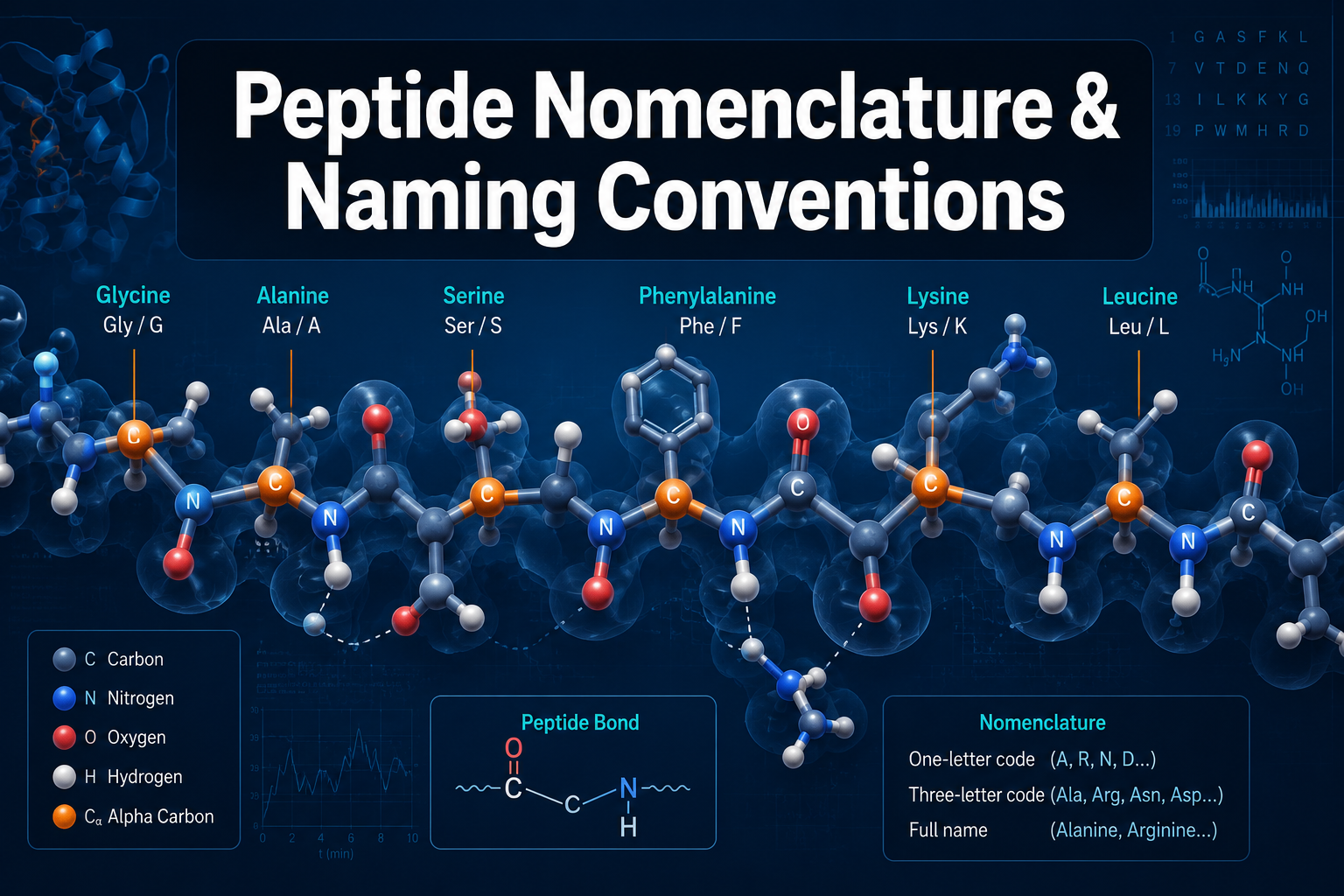
Peptide nomenclature is the standardized system used to name and describe peptides based on their amino acid composition, sequence, and structural features. The rules, largely established by the International Union of Pure and Applied Chemistry (IUPAC) and the International Union of Biochemistry and Molecular Biology (IUBMB), specify how to list amino acids from the N-terminus to the C-terminus, which abbreviation codes to use, and how to denote modifications or unusual structural features. Understanding peptide nomenclature and naming conventions is essential for anyone working in biochemistry, pharmaceutical development, or peptide research.
Key Takeaways
- Peptides are named by listing amino acid residues from the N-terminus (left) to the C-terminus (right).
- Both single-letter codes (e.g., G, A, V) and three-letter codes (e.g., Gly, Ala, Val) are acceptable; three-letter codes are standard in formal scientific writing.
- Hyphens between three-letter codes indicate peptide bonds; no hyphens are used in single-letter sequences.
- Modified or non-standard residues are typically enclosed in brackets or parentheses within the sequence.
- Cyclic peptides require specific notation to distinguish them from linear peptides.
- Disulfide bonds are denoted by indicating the positions of the cysteine residues involved.
- Pharmaceutical peptide drugs follow additional naming rules set by bodies such as the World Health Organization (WHO) International Nonproprietary Name (INN) program.
- The most authoritative source for official rules is the IUPAC-IUBMB joint nomenclature recommendations.
What Is Peptide Nomenclature and Why Does It Matter
Peptide nomenclature is the formal set of rules governing how peptides are named, written, and communicated in scientific literature. Without a shared naming system, researchers, clinicians, and manufacturers would struggle to communicate precisely about the same molecule.
Clear naming conventions matter for several practical reasons:
- Reproducibility: A researcher in Tokyo and one in Toronto must be describing the same molecule when they use the same name.
- Regulatory compliance: Pharmaceutical agencies require unambiguous names for drug approval submissions.
- Database accuracy: Repositories such as UniProt and PubChem rely on standardized names to index peptides correctly.
- Safety: In clinical settings, naming errors can lead to the wrong peptide being synthesized or administered.
Understanding peptide nomenclature and naming conventions is therefore not just an academic exercise. It is a practical requirement for anyone involved in peptide synthesis, drug development, or biological research.
How Do You Name Peptides with Amino Acid Sequences
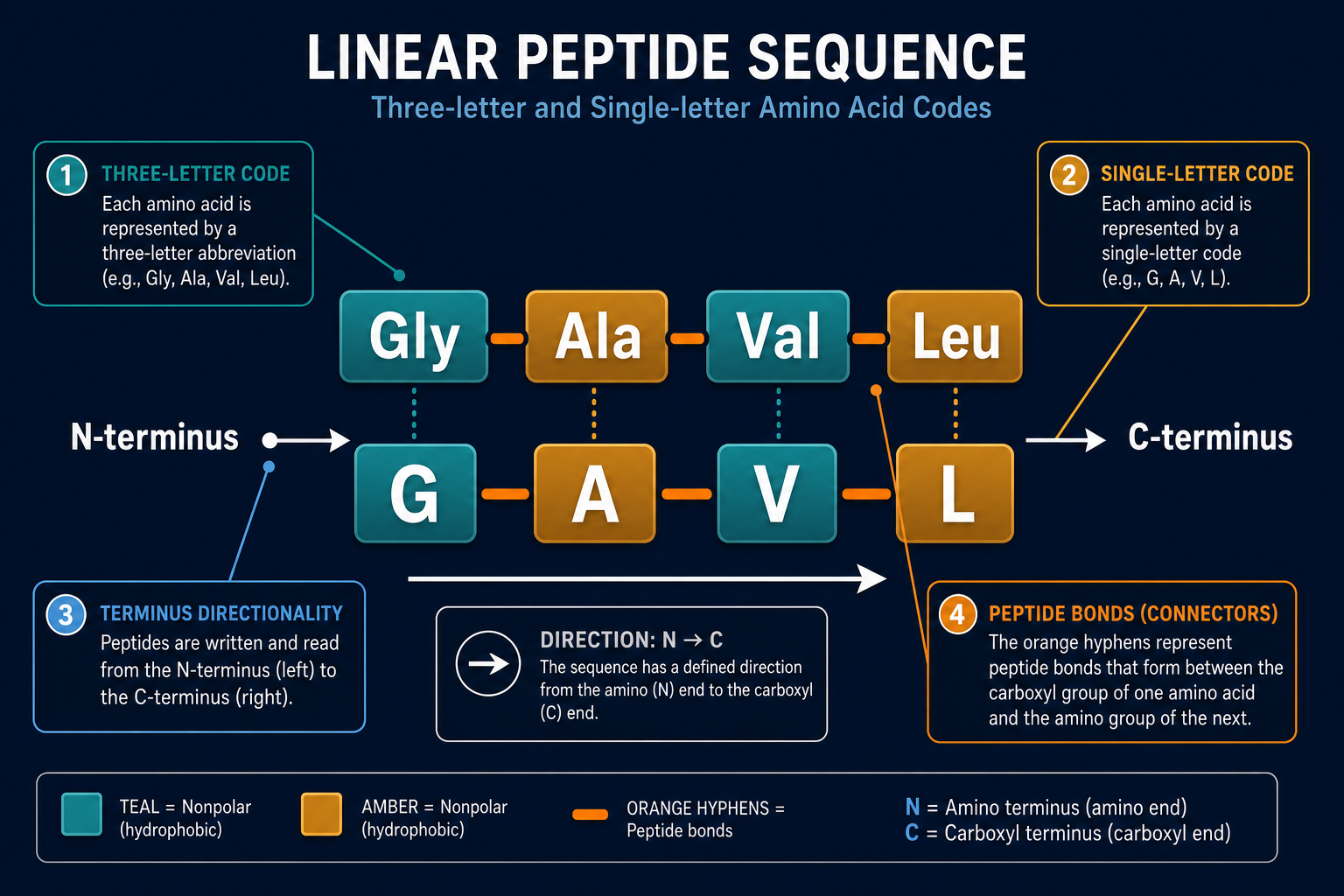
A peptide is named by listing its constituent amino acid residues in order, starting from the free amino terminus (N-terminus) and ending at the free carboxyl terminus (C-terminus). Each residue except the last is named as an acyl group, with the suffix “-yl” replacing the “-ine” or “-ic acid” ending of the amino acid name. The final residue retains its full name.
Example: A tripeptide made of glycine, alanine, and valine is named glycyl-alanyl-valine, or in abbreviated form, Gly-Ala-Val.
Key rules for sequence-based naming:
- Always write N-terminus on the left, C-terminus on the right.
- Use three-letter codes separated by hyphens for formal written names.
- Use single-letter codes written as a continuous string (no hyphens) for sequence databases and bioinformatics.
- For longer peptides (generally more than five residues), single-letter code strings are preferred for brevity.
What Is the Difference Between Single-Letter and Three-Letter Amino Acid Codes
Three-letter codes (e.g., Gly, Ala, Ser) are the standard in formal biochemistry publications, while single-letter codes (e.g., G, A, S) are used in sequence databases, alignments, and computational tools. Both code systems are defined by IUPAC-IUBMB recommendations.
| Amino Acid | Three-Letter Code | Single-Letter Code |
|---|---|---|
| Glycine | Gly | G |
| Alanine | Ala | A |
| Valine | Val | V |
| Leucine | Leu | L |
| Serine | Ser | S |
| Cysteine | Cys | C |
| Lysine | Lys | K |
| Phenylalanine | Phe | F |
Choose three-letter codes when: writing journal articles, patent applications, or regulatory documents where clarity is paramount.
Choose single-letter codes when: working with sequence alignment software, genomic databases, or any context where a long sequence must be written compactly.
A common mistake is mixing the two systems within the same sequence notation, which creates ambiguity and should always be avoided.
How Do You Read a Peptide Sequence from N-Terminus to C-Terminus
By convention, all peptide sequences are read and written from left to right, starting at the N-terminus (the end with a free amino group, -NH2) and ending at the C-terminus (the end with a free carboxyl group, -COOH). This direction mirrors the order in which ribosomes synthesize peptides during translation.
Practical reading rule: The leftmost residue in any written sequence is always the N-terminal residue. If a sequence is written as Ala-Gly-Leu, alanine is at the N-terminus and leucine is at the C-terminus.
Reversing this order would describe a completely different peptide with different biological properties, so directionality is non-negotiable in peptide nomenclature.
What Does the Hyphen Mean in Peptide Naming
In peptide nomenclature, a hyphen between three-letter amino acid codes represents a peptide bond between those two residues. For example, Gly-Ala indicates that glycine and alanine are joined by a peptide bond, with glycine at the N-terminal side.
Hyphens are not used in single-letter code sequences. Writing “GAVC” means the same thing as Gly-Ala-Val-Cys, but the hyphen notation is reserved for three-letter code representations.
Edge case: When a hyphen appears at the beginning or end of a sequence (e.g., H-Gly-Ala-OH), it signals that the terminal groups are free and unmodified. “H-” denotes a free amino group and “-OH” denotes a free carboxyl group. This notation is especially common in solid-phase peptide synthesis documentation.
Why Do Some Peptides Have Numbers in Their Names and What Do Brackets or Parentheses Mean
Numbers in peptide names typically indicate the position of a specific residue within a longer sequence, or they identify a particular variant or isoform. For example, Substance P(1-7) refers to the fragment of Substance P spanning residues 1 through 7.
Brackets and parentheses serve distinct purposes:
- Brackets [ ] enclose non-standard or modified amino acid residues. For example, [D-Ala2] in a peptide name means the alanine at position 2 has the D-configuration rather than the natural L-configuration.
- Parentheses ( ) are used to indicate fragment positions or to group modifications, as in the fragment notation above.
Example: [D-Ala2, D-Leu5]-Enkephalin is a modified form of enkephalin where position 2 is D-alanine and position 5 is D-leucine. This notation immediately tells a chemist which residues differ from the natural sequence.
How Do You Name Modified or Non-Standard Peptides
Modified peptides include those with non-natural amino acids, chemical modifications at the termini, side-chain alterations, or isotopic labels. The general rule is to specify the modification in brackets immediately before the affected residue’s code, along with its position number.
Common modification notations:
- N-terminal acetylation: Ac-Gly-Ala-Val-OH (Ac = acetyl group)
- C-terminal amidation: H-Gly-Ala-Val-NH2
- Phosphorylation: [pSer3] or Ser(PO3H2) to indicate phosphoserine at position 3
- D-amino acids: [D-Phe] or lowercase single-letter code (f for D-phenylalanine in some conventions)
- Isotopic labeling: Residues labeled with heavy isotopes are noted in brackets, e.g., [13C6, 15N2-Lys]
When a peptide contains entirely non-standard residues, the naming follows the same N-to-C direction but each unusual residue must be explicitly identified. Ambiguity in modified peptide names is one of the most frequent sources of error in synthesis requests.
How Do You Name Cyclic Peptides Versus Linear Peptides
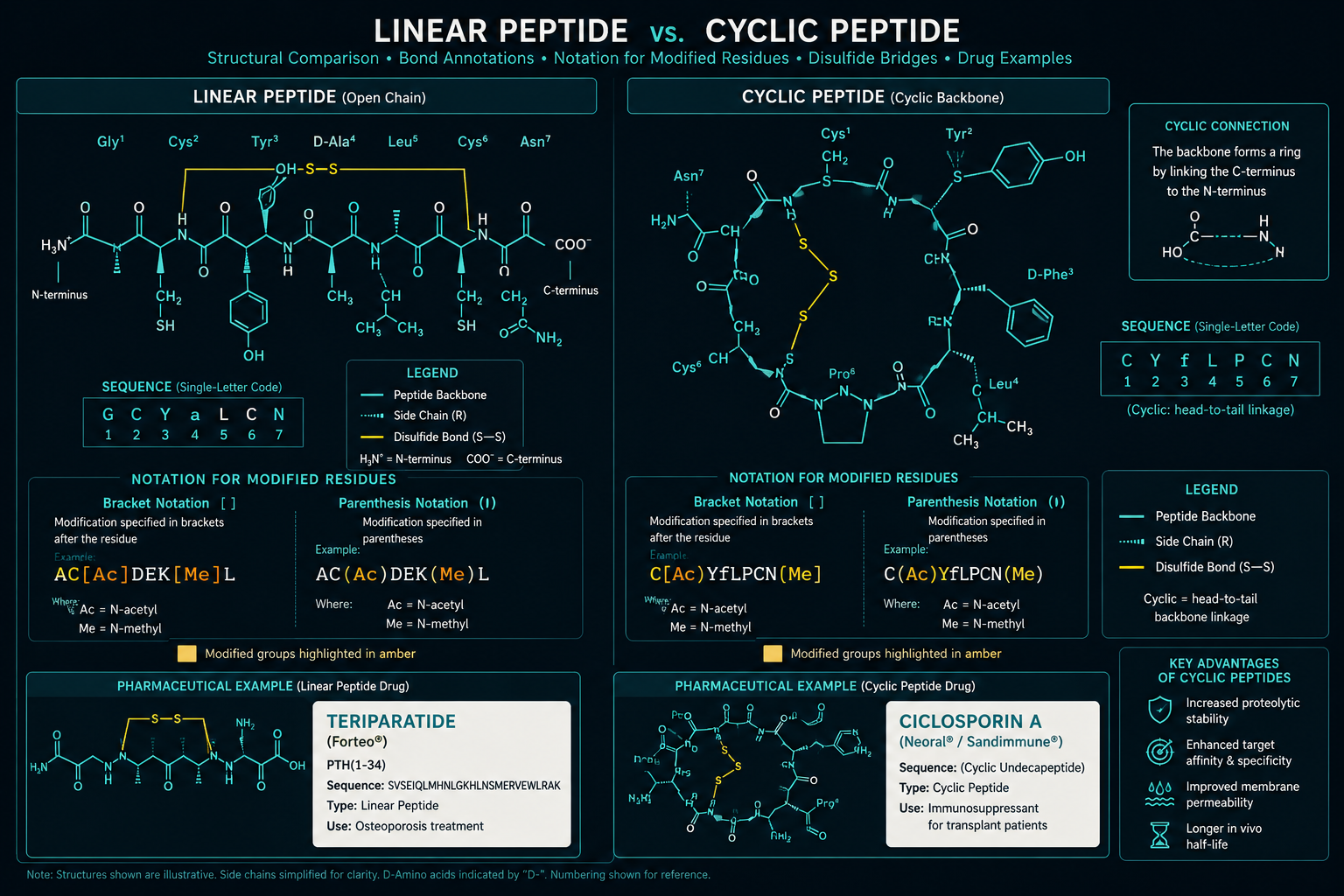
Linear peptides have free N- and C-termini, while cyclic peptides form a closed ring through a bond between two residues or between a terminus and a side chain. Cyclic peptides require explicit notation because the standard linear sequence format does not convey the ring structure.
Naming conventions for cyclic peptides:
- Head-to-tail cyclization (N-terminus bonded to C-terminus): The prefix “cyclo” is placed before the sequence, written in parentheses. Example: cyclo(Gly-Ala-Phe-Leu).
- Side-chain-to-terminus cyclization: The specific bond must be described, often using superscript numbers or explicit bond descriptions.
- Lactam or lactone bridges: These are noted by indicating the residue positions involved.
Cyclic peptides such as cyclosporin A are named using systematic cyclo notation in scientific literature, even when they also carry a common drug name.
How Do You Name Peptides with Disulfide Bonds
Disulfide bonds form between the thiol groups of two cysteine residues. In peptide nomenclature, disulfide bonds are indicated by specifying the positions of the two cysteine residues involved, connected by a superscript or bracket notation.
Standard notation: For a peptide with a disulfide bond between Cys3 and Cys8, the name would include the notation (Cys3-Cys8) or a superscript bridge indicator. In longer sequences, the IUPAC recommendation is to list disulfide bridges after the sequence in the format: disulfide bond: 3-8.
When multiple disulfide bonds are present (as in insulin, which has two inter-chain and one intra-chain disulfide bond), each bond is listed separately. Misidentifying disulfide bond positions is a critical error because it describes a completely different three-dimensional structure.
What Is the Difference Between Peptide Nomenclature and Protein Nomenclature
Peptide nomenclature focuses on short chains (generally up to about 50 amino acid residues) and uses sequence-based naming with explicit residue listings. Protein nomenclature, by contrast, relies primarily on functional names, gene names, and systematic identifiers rather than listing every residue in the name.
Key differences:
- Proteins are named for their function (e.g., hemoglobin, insulin) or gene product (e.g., BRCA1 protein), not their full sequence.
- Peptides shorter than roughly 20 residues are commonly named by their full sequence using three-letter or single-letter codes.
- Proteins are catalogued using identifiers like UniProt accession numbers; peptides in databases like PeptideAtlas use sequence strings.
- The boundary is not rigid: some biologically active peptides (e.g., glucagon at 29 residues) are named by function but can also be written in full sequence notation.
How Do Pharmaceutical Companies Name Peptide Drugs
Pharmaceutical peptide drugs receive names through the WHO INN program, which assigns a nonproprietary (generic) name that is globally recognized. For peptide drugs, the INN system uses specific stems to indicate the drug class.
Common INN stems for peptide drugs:
- -tide: General peptide suffix (e.g., octreotide, leuprolide)
- -relix: GnRH antagonists (e.g., cetrorelix, degarelix)
- -relin: GnRH agonists (e.g., buserelin, gonadorelin)
Beyond the INN name, pharmaceutical companies also maintain the full chemical name using IUPAC peptide nomenclature in regulatory filings, which includes the complete amino acid sequence with all modifications noted. Brand names (trade names) are separate and follow marketing conventions rather than scientific naming rules.
Where Can You Find the Official Rules for Peptide Naming
The primary authoritative source is the IUPAC-IUBMB joint recommendations on the nomenclature and symbolism for amino acids and peptides, published in Pure and Applied Chemistry. These recommendations cover standard amino acids, abbreviations, and rules for naming peptides, modified residues, and cyclic structures.
Additional resources:
- IUPAC official website (iupac.org): Hosts the full text of nomenclature recommendations.
- IUBMB Nomenclature Committee: Publishes updates and clarifications on biochemical naming.
- PubChem and ChemSpider: Apply IUPAC naming rules in their database entries and can be used to cross-check names.
- Journal author guidelines: Most biochemistry journals (e.g., Journal of Peptide Science, Biochemistry) include specific formatting requirements for peptide sequences that align with IUPAC-IUBMB standards.
What Common Mistakes Do People Make When Naming Peptides
Even experienced researchers make naming errors. The most frequent ones include:
- Reversing the sequence direction: Writing C-terminus to N-terminus is a fundamental error that describes a different molecule.
- Mixing single-letter and three-letter codes in the same sequence string.
- Omitting modification descriptors: Failing to note D-amino acids, phosphorylation, or terminal modifications leads to incorrect synthesis.
- Incorrect cyclic notation: Writing a cyclic peptide as a linear sequence without the “cyclo” prefix.
- Forgetting to specify disulfide bond positions when multiple cysteines are present.
- Using trade names as scientific names: Brand names like Ozempic do not substitute for the INN name (semaglutide) or the full IUPAC sequence name in scientific writing.
FAQ
What is the shortest peptide that requires formal nomenclature?
Even a dipeptide (two amino acids) follows the same naming rules. For example, glycyl-alanine (Gly-Ala) uses the standard N-to-C direction with the “-yl” suffix on the first residue.
Can a peptide have more than one accepted name?
Yes. A peptide may have a systematic IUPAC name, a common name (e.g., oxytocin), an INN name if it is a drug, and a sequence string. All can refer to the same molecule, but the systematic name is the most precise.
What does “H-” at the start of a peptide name mean?
“H-” indicates that the N-terminus is free (unmodified), carrying a hydrogen atom on the amino group. It distinguishes the peptide from one with an acetylated or otherwise blocked N-terminus.
Are amino acid codes case-sensitive?
Yes. Three-letter codes capitalize only the first letter (Gly, not GLY or gly). Single-letter codes for L-amino acids are uppercase; lowercase single-letter codes sometimes denote D-amino acids in informal notation, though this is not universally standardized.
How is a peptide fragment named?
Fragments are named using the parent peptide’s name followed by the residue range in parentheses. For example, beta-endorphin(1-5) refers to the first five residues of beta-endorphin.
What does “NH2” at the end of a peptide name mean?
“-NH2” indicates that the C-terminus is amidated (the carboxyl group is replaced by an amide group). This modification is common in synthetic peptides and affects stability and biological activity.
Is there a difference between peptide and oligopeptide nomenclature?
No fundamental difference exists. “Oligopeptide” simply refers to a short peptide (typically 2-20 residues), and the same IUPAC-IUBMB naming rules apply regardless of chain length.
How are isotopically labeled peptides named?
The isotope label is specified in brackets before the residue code, including the isotope symbol and mass number. For example, [13C6]-Leu indicates leucine labeled with carbon-13 at all six carbon positions.
Do all journals use the same peptide naming format?
Most follow IUPAC-IUBMB recommendations, but formatting details (hyphen use, bracket styles) can vary slightly by journal style guide. Always check the target journal’s author instructions.
Conclusion
Understanding peptide nomenclature and naming conventions is a foundational skill for anyone working with these molecules, whether in a research lab, a pharmaceutical company, or a clinical setting. The rules are logical once the core principles are clear: always write sequences from N-terminus to C-terminus, use the appropriate abbreviation system consistently, and explicitly describe any modifications or structural features such as cyclization or disulfide bonds.
Actionable next steps:
- Bookmark the IUPAC-IUBMB nomenclature recommendations at iupac.org as a primary reference.
- When writing peptide sequences in publications, default to three-letter codes with hyphens for formal clarity.
- For any modified peptide, draft the full name with all modifications in brackets before submitting a synthesis request to avoid costly errors.
- Cross-check peptide drug names against the WHO INN database to confirm the correct nonproprietary name for regulatory or clinical documents.
- If working with cyclic peptides or those containing disulfide bonds, explicitly state the ring-forming bond or bridge positions every time the peptide is named in a document.
Consistent application of these conventions reduces errors, improves reproducibility, and ensures that scientific communication about peptides remains precise across disciplines and borders.
References
- IUPAC-IUBMB Joint Commission on Biochemical Nomenclature. “Nomenclature and Symbolism for Amino Acids and Peptides.” Pure and Applied Chemistry, 1984. https://iupac.org/recommendation/nomenclature-and-symbolism-for-amino-acids-and-peptides/
- Nomenclature Committee of the International Union of Biochemistry and Molecular Biology (NC-IUBMB). Amino Acid and Peptide Nomenclature. https://www.qmul.ac.uk/sbcs/iubmb/
- World Health Organization. “International Nonproprietary Names (INN) for Pharmaceutical Substances.” WHO INN Programme. https://www.who.int/teams/health-product-and-policy-standards/inn
- Fasman, G. D. (Ed.). Practical Handbook of Biochemistry and Molecular Biology. CRC Press, 1989.
- Craik, D. J., Fairlie, D. P., Liras, S., & Price, D. “The Future of Peptide-based Drugs.” Chemical Biology & Drug Design, 2013. https://doi.org/10.1111/cbdd.12055
Meta Title: Peptide Nomenclature and Naming Conventions Explained
Meta Description: Learn how peptide nomenclature works, from amino acid codes and sequence direction to cyclic peptides, modifications, and pharmaceutical naming rules. Updated 2026.
Tags: peptide nomenclature, amino acid codes, peptide naming conventions, N-terminus C-terminus, single letter amino acid code, three letter amino acid code, cyclic peptides, modified peptides, disulfide bonds, pharmaceutical peptide naming, IUPAC peptide rules, peptide sequence notation
Understanding Peptide Nomenclature and Naming Conventions
Last updated: July 1, 2026
Quick Answer
Peptide nomenclature is the standardized system used to name and describe peptides based on their amino acid composition, sequence, and structural features. The rules, largely established by the International Union of Pure and Applied Chemistry (IUPAC) and the International Union of Biochemistry and Molecular Biology (IUBMB), specify how to list amino acids from the N-terminus to the C-terminus, which abbreviation codes to use, and how to denote modifications or unusual structural features. Understanding peptide nomenclature and naming conventions is essential for anyone working in biochemistry, pharmaceutical development, or peptide research.
Key Takeaways
- Peptides are named by listing amino acid residues from the N-terminus (left) to the C-terminus (right).
- Both single-letter codes (e.g., G, A, V) and three-letter codes (e.g., Gly, Ala, Val) are acceptable; three-letter codes are standard in formal scientific writing.
- Hyphens between three-letter codes indicate peptide bonds; no hyphens are used in single-letter sequences.
- Modified or non-standard residues are typically enclosed in brackets or parentheses within the sequence.
- Cyclic peptides require specific notation to distinguish them from linear peptides.
- Disulfide bonds are denoted by indicating the positions of the cysteine residues involved.
- Pharmaceutical peptide drugs follow additional naming rules set by bodies such as the World Health Organization (WHO) International Nonproprietary Name (INN) program.
- The most authoritative source for official rules is the IUPAC-IUBMB joint nomenclature recommendations.
What Is Peptide Nomenclature and Why Does It Matter
Peptide nomenclature is the formal set of rules governing how peptides are named, written, and communicated in scientific literature. Without a shared naming system, researchers, clinicians, and manufacturers would struggle to communicate precisely about the same molecule.
Clear naming conventions matter for several practical reasons:
- Reproducibility: A researcher in Tokyo and one in Toronto must be describing the same molecule when they use the same name.
- Regulatory compliance: Pharmaceutical agencies require unambiguous names for drug approval submissions.
- Database accuracy: Repositories such as UniProt and PubChem rely on standardized names to index peptides correctly.
- Safety: In clinical settings, naming errors can lead to the wrong peptide being synthesized or administered.
Understanding peptide nomenclature and naming conventions is therefore not just an academic exercise. It is a practical requirement for anyone involved in peptide synthesis, drug development, or biological research.
How Do You Name Peptides with Amino Acid Sequences
A peptide is named by listing its constituent amino acid residues in order, starting from the free amino terminus (N-terminus) and ending at the free carboxyl terminus (C-terminus). Each residue except the last is named as an acyl group, with the suffix “-yl” replacing the “-ine” or “-ic acid” ending of the amino acid name. The final residue retains its full name.
Example: A tripeptide made of glycine, alanine, and valine is named glycyl-alanyl-valine, or in abbreviated form, Gly-Ala-Val.
Key rules for sequence-based naming:
- Always write N-terminus on the left, C-terminus on the right.
- Use three-letter codes separated by hyphens for formal written names.
- Use single-letter codes written as a continuous string (no hyphens) for sequence databases and bioinformatics.
- For longer peptides (generally more than five residues), single-letter code strings are preferred for brevity.
What Is the Difference Between Single-Letter and Three-Letter Amino Acid Codes
Three-letter codes (e.g., Gly, Ala, Ser) are the standard in formal biochemistry publications, while single-letter codes (e.g., G, A, S) are used in sequence databases, alignments, and computational tools. Both code systems are defined by IUPAC-IUBMB recommendations.
| Amino Acid | Three-Letter Code | Single-Letter Code |
|---|---|---|
| Glycine | Gly | G |
| Alanine | Ala | A |
| Valine | Val | V |
| Leucine | Leu | L |
| Serine | Ser | S |
| Cysteine | Cys | C |
| Lysine | Lys | K |
| Phenylalanine | Phe | F |
Choose three-letter codes when: writing journal articles, patent applications, or regulatory documents where clarity is paramount.
Choose single-letter codes when: working with sequence alignment software, genomic databases, or any context where a long sequence must be written compactly.
A common mistake is mixing the two systems within the same sequence notation, which creates ambiguity and should always be avoided.
How Do You Read a Peptide Sequence from N-Terminus to C-Terminus
By convention, all peptide sequences are read and written from left to right, starting at the N-terminus (the end with a free amino group, -NH2) and ending at the C-terminus (the end with a free carboxyl group, -COOH). This direction mirrors the order in which ribosomes synthesize peptides during translation.
Practical reading rule: The leftmost residue in any written sequence is always the N-terminal residue. If a sequence is written as Ala-Gly-Leu, alanine is at the N-terminus and leucine is at the C-terminus.
Reversing this order would describe a completely different peptide with different biological properties, so directionality is non-negotiable in peptide nomenclature.
What Does the Hyphen Mean in Peptide Naming
In peptide nomenclature, a hyphen between three-letter amino acid codes represents a peptide bond between those two residues. For example, Gly-Ala indicates that glycine and alanine are joined by a peptide bond, with glycine at the N-terminal side.
Hyphens are not used in single-letter code sequences. Writing “GAVC” means the same thing as Gly-Ala-Val-Cys, but the hyphen notation is reserved for three-letter code representations.
Edge case: When a hyphen appears at the beginning or end of a sequence (e.g., H-Gly-Ala-OH), it signals that the terminal groups are free and unmodified. “H-” denotes a free amino group and “-OH” denotes a free carboxyl group. This notation is especially common in solid-phase peptide synthesis documentation.
Why Do Some Peptides Have Numbers in Their Names and What Do Brackets or Parentheses Mean
Numbers in peptide names typically indicate the position of a specific residue within a longer sequence, or they identify a particular variant or isoform. For example, Substance P(1-7) refers to the fragment of Substance P spanning residues 1 through 7.
Brackets and parentheses serve distinct purposes:
- Brackets [ ] enclose non-standard or modified amino acid residues. For example, [D-Ala2] in a peptide name means the alanine at position 2 has the D-configuration rather than the natural L-configuration.
- Parentheses ( ) are used to indicate fragment positions or to group modifications, as in the fragment notation above.
Example: [D-Ala2, D-Leu5]-Enkephalin is a modified form of enkephalin where position 2 is D-alanine and position 5 is D-leucine. This notation immediately tells a chemist which residues differ from the natural sequence.
How Do You Name Modified or Non-Standard Peptides
Modified peptides include those with non-natural amino acids, chemical modifications at the termini, side-chain alterations, or isotopic labels. The general rule is to specify the modification in brackets immediately before the affected residue’s code, along with its position number.
Common modification notations:
- N-terminal acetylation: Ac-Gly-Ala-Val-OH (Ac = acetyl group)
- C-terminal amidation: H-Gly-Ala-Val-NH2
- Phosphorylation: [pSer3] or Ser(PO3H2) to indicate phosphoserine at position 3
- D-amino acids: [D-Phe] or lowercase single-letter code (f for D-phenylalanine in some conventions)
- Isotopic labeling: Residues labeled with heavy isotopes are noted in brackets, e.g., [13C6, 15N2-Lys]
When a peptide contains entirely non-standard residues, the naming follows the same N-to-C direction but each unusual residue must be explicitly identified. Ambiguity in modified peptide names is one of the most frequent sources of error in synthesis requests.
How Do You Name Cyclic Peptides Versus Linear Peptides
Linear peptides have free N- and C-termini, while cyclic peptides form a closed ring through a bond between two residues or between a terminus and a side chain. Cyclic peptides require explicit notation because the standard linear sequence format does not convey the ring structure.
Naming conventions for cyclic peptides:
- Head-to-tail cyclization (N-terminus bonded to C-terminus): The prefix “cyclo” is placed before the sequence, written in parentheses. Example: cyclo(Gly-Ala-Phe-Leu).
- Side-chain-to-terminus cyclization: The specific bond must be described, often using superscript numbers or explicit bond descriptions.
- Lactam or lactone bridges: These are noted by indicating the residue positions involved.
Cyclic peptides such as cyclosporin A are named using systematic cyclo notation in scientific literature, even when they also carry a common drug name.
How Do You Name Peptides with Disulfide Bonds
Disulfide bonds form between the thiol groups of two cysteine residues. In peptide nomenclature, disulfide bonds are indicated by specifying the positions of the two cysteine residues involved, connected by a superscript or bracket notation.
Standard notation: For a peptide with a disulfide bond between Cys3 and Cys8, the name would include the notation (Cys3-Cys8) or a superscript bridge indicator. In longer sequences, the IUPAC recommendation is to list disulfide bridges after the sequence in the format: disulfide bond: 3-8.
When multiple disulfide bonds are present (as in insulin, which has two inter-chain and one intra-chain disulfide bond), each bond is listed separately. Misidentifying disulfide bond positions is a critical error because it describes a completely different three-dimensional structure.
What Is the Difference Between Peptide Nomenclature and Protein Nomenclature
Peptide nomenclature focuses on short chains (generally up to about 50 amino acid residues) and uses sequence-based naming with explicit residue listings. Protein nomenclature, by contrast, relies primarily on functional names, gene names, and systematic identifiers rather than listing every residue in the name.
Key differences:
- Proteins are named for their function (e.g., hemoglobin, insulin) or gene product (e.g., BRCA1 protein), not their full sequence.
- Peptides shorter than roughly 20 residues are commonly named by their full sequence using three-letter or single-letter codes.
- Proteins are catalogued using identifiers like UniProt accession numbers; peptides in databases like PeptideAtlas use sequence strings.
- The boundary is not rigid: some biologically active peptides (e.g., glucagon at 29 residues) are named by function but can also be written in full sequence notation.
How Do Pharmaceutical Companies Name Peptide Drugs
Pharmaceutical peptide drugs receive names through the WHO INN program, which assigns a nonproprietary (generic) name that is globally recognized. For peptide drugs, the INN system uses specific stems to indicate the drug class.
Common INN stems for peptide drugs:
- -tide: General peptide suffix (e.g., octreotide, leuprolide)
- -relix: GnRH antagonists (e.g., cetrorelix, degarelix)
- -relin: GnRH agonists (e.g., buserelin, gonadorelin)
Beyond the INN name, pharmaceutical companies also maintain the full chemical name using IUPAC peptide nomenclature in regulatory filings, which includes the complete amino acid sequence with all modifications noted. Brand names (trade names) are separate and follow marketing conventions rather than scientific naming rules.
Where Can You Find the Official Rules for Peptide Naming
The primary authoritative source is the IUPAC-IUBMB joint recommendations on the nomenclature and symbolism for amino acids and peptides, published in Pure and Applied Chemistry. These recommendations cover standard amino acids, abbreviations, and rules for naming peptides, modified residues, and cyclic structures.
Additional resources:
- IUPAC official website (iupac.org): Hosts the full text of nomenclature recommendations.
- IUBMB Nomenclature Committee: Publishes updates and clarifications on biochemical naming.
- PubChem and ChemSpider: Apply IUPAC naming rules in their database entries and can be used to cross-check names.
- Journal author guidelines: Most biochemistry journals (e.g., Journal of Peptide Science, Biochemistry) include specific formatting requirements for peptide sequences that align with IUPAC-IUBMB standards.
What Common Mistakes Do People Make When Naming Peptides
Even experienced researchers make naming errors. The most frequent ones include:
- Reversing the sequence direction: Writing C-terminus to N-terminus is a fundamental error that describes a different molecule.
- Mixing single-letter and three-letter codes in the same sequence string.
- Omitting modification descriptors: Failing to note D-amino acids, phosphorylation, or terminal modifications leads to incorrect synthesis.
- Incorrect cyclic notation: Writing a cyclic peptide as a linear sequence without the “cyclo” prefix.
- Forgetting to specify disulfide bond positions when multiple cysteines are present.
- Using trade names as scientific names: Brand names like Ozempic do not substitute for the INN name (semaglutide) or the full IUPAC sequence name in scientific writing.
FAQ
What is the shortest peptide that requires formal nomenclature?
Even a dipeptide (two amino acids) follows the same naming rules. For example, glycyl-alanine (Gly-Ala) uses the standard N-to-C direction with the “-yl” suffix on the first residue.
Can a peptide have more than one accepted name?
Yes. A peptide may have a systematic IUPAC name, a common name (e.g., oxytocin), an INN name if it is a drug, and a sequence string. All can refer to the same molecule, but the systematic name is the most precise.
What does “H-” at the start of a peptide name mean?
“H-” indicates that the N-terminus is free (unmodified), carrying a hydrogen atom on the amino group. It distinguishes the peptide from one with an acetylated or otherwise blocked N-terminus.
Are amino acid codes case-sensitive?
Yes. Three-letter codes capitalize only the first letter (Gly, not GLY or gly). Single-letter codes for L-amino acids are uppercase; lowercase single-letter codes sometimes denote D-amino acids in informal notation, though this is not universally standardized.
How is a peptide fragment named?
Fragments are named using the parent peptide’s name followed by the residue range in parentheses. For example, beta-endorphin(1-5) refers to the first five residues of beta-endorphin.
What does “NH2” at the end of a peptide name mean?
“-NH2” indicates that the C-terminus is amidated (the carboxyl group is replaced by an amide group). This modification is common in synthetic peptides and affects stability and biological activity.
Is there a difference between peptide and oligopeptide nomenclature?
No fundamental difference exists. “Oligopeptide” simply refers to a short peptide (typically 2-20 residues), and the same IUPAC-IUBMB naming rules apply regardless of chain length.
How are isotopically labeled peptides named?
The isotope label is specified in brackets before the residue code, including the isotope symbol and mass number. For example, [13C6]-Leu indicates leucine labeled with carbon-13 at all six carbon positions.
Do all journals use the same peptide naming format?
Most follow IUPAC-IUBMB recommendations, but formatting details (hyphen use, bracket styles) can vary slightly by journal style guide. Always check the target journal’s author instructions.
Conclusion
Understanding peptide nomenclature and naming conventions is a foundational skill for anyone working with these molecules, whether in a research lab, a pharmaceutical company, or a clinical setting. The rules are logical once the core principles are clear: always write sequences from N-terminus to C-terminus, use the appropriate abbreviation system consistently, and explicitly describe any modifications or structural features such as cyclization or disulfide bonds.
Actionable next steps:
- Bookmark the IUPAC-IUBMB nomenclature recommendations at iupac.org as a primary reference.
- When writing peptide sequences in publications, default to three-letter codes with hyphens for formal clarity.
- For any modified peptide, draft the full name with all modifications in brackets before submitting a synthesis request to avoid costly errors.
- Cross-check peptide drug names against the WHO INN database to confirm the correct nonproprietary name for regulatory or clinical documents.
- If working with cyclic peptides or those containing disulfide bonds, explicitly state the ring-forming bond or bridge positions every time the peptide is named in a document.
Consistent application of these conventions reduces errors, improves reproducibility, and ensures that scientific communication about peptides remains precise across disciplines and borders.
References
- IUPAC-IUBMB Joint Commission on Biochemical Nomenclature. “Nomenclature and Symbolism for Amino Acids and Peptides.” Pure and Applied Chemistry, 1984. https://iupac.org/recommendation/nomenclature-and-symbolism-for-amino-acids-and-peptides/
- Nomenclature Committee of the International Union of Biochemistry and Molecular Biology (NC-IUBMB). Amino Acid and Peptide Nomenclature. https://www.qmul.ac.uk/sbcs/iubmb/
- World Health Organization. “International Nonproprietary Names (INN) for Pharmaceutical Substances.” WHO INN Programme. https://www.who.int/teams/health-product-and-policy-standards/inn
- Fasman, G. D. (Ed.). Practical Handbook of Biochemistry and Molecular Biology. CRC Press, 1989.
- Craik, D. J., Fairlie, D. P., Liras, S., & Price, D. “The Future of Peptide-based Drugs.” Chemical Biology & Drug Design, 2013. https://doi.org/10.1111/cbdd.12055
Meta Title: Peptide Nomenclature and Naming Conventions Explained
Meta Description: Learn how peptide nomenclature works, from amino acid codes and sequence direction to cyclic peptides, modifications, and pharmaceutical naming rules. Updated 2026.
Tags: peptide nomenclature, amino acid codes, peptide naming conventions, N-terminus C-terminus, single letter amino acid code, three letter amino acid code, cyclic peptides, modified peptides, disulfide bonds, pharmaceutical peptide naming, IUPAC peptide rules, peptide sequence notation
