
No products in the cart.
Last updated: July 1, 2026
Quick Answer: Lyophilized (freeze-dried) peptides are peptide compounds that have had nearly all moisture removed through a controlled freezing and vacuum-drying process, leaving behind a stable white powder. This method dramatically extends shelf life, prevents degradation, and makes peptides far easier to store and ship than liquid formulations. Researchers, pharmaceutical manufacturers, and clinical labs rely on lyophilization as the gold standard for preserving peptide integrity.
Key Takeaways
- Lyophilization removes water from frozen peptides under vacuum, converting ice directly to vapor without passing through a liquid phase.
- Lyophilized peptides can remain stable for two years or more when stored correctly, compared to days or weeks for liquid peptide solutions.
- The process protects peptides from hydrolysis, oxidation, and microbial growth, all of which degrade liquid formulations rapidly.
- Reconstitution requires adding a specific sterile solvent (typically sterile water or a buffer solution) before use.
- Lyophilized peptides are not inherently “better” in biological activity than fresh liquid peptides, but they are far more practical for storage, shipping, and quality control.
- Improper storage (humidity, heat, or light exposure) can still degrade lyophilized peptides even in powder form.
- Most commercially sold research peptides, vaccine antigens, and therapeutic peptides are supplied in lyophilized form.
- Lyophilization adds cost to manufacturing, but the extended stability typically justifies the expense for high-value peptide compounds.
What Does Lyophilized Mean in Simple Terms
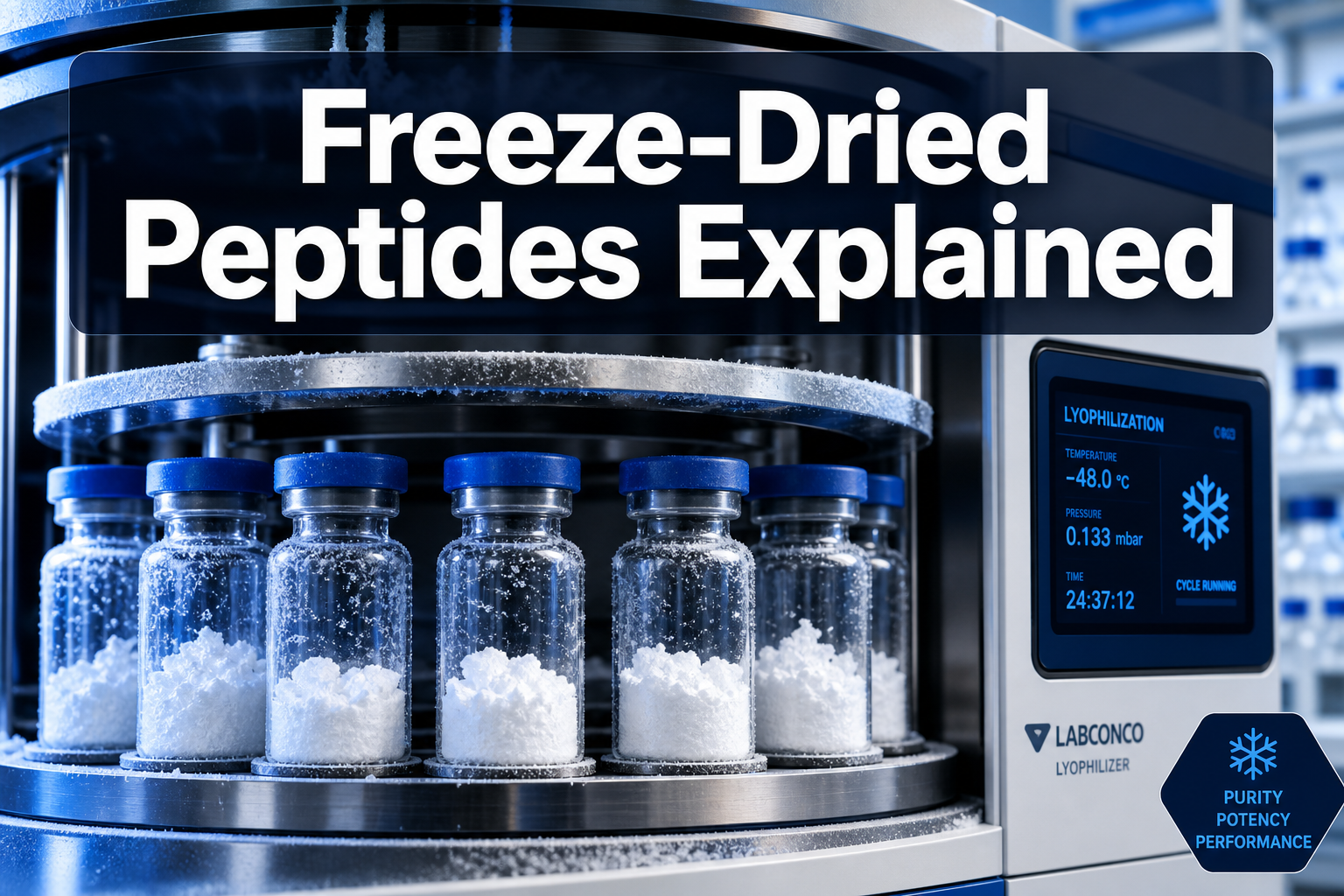
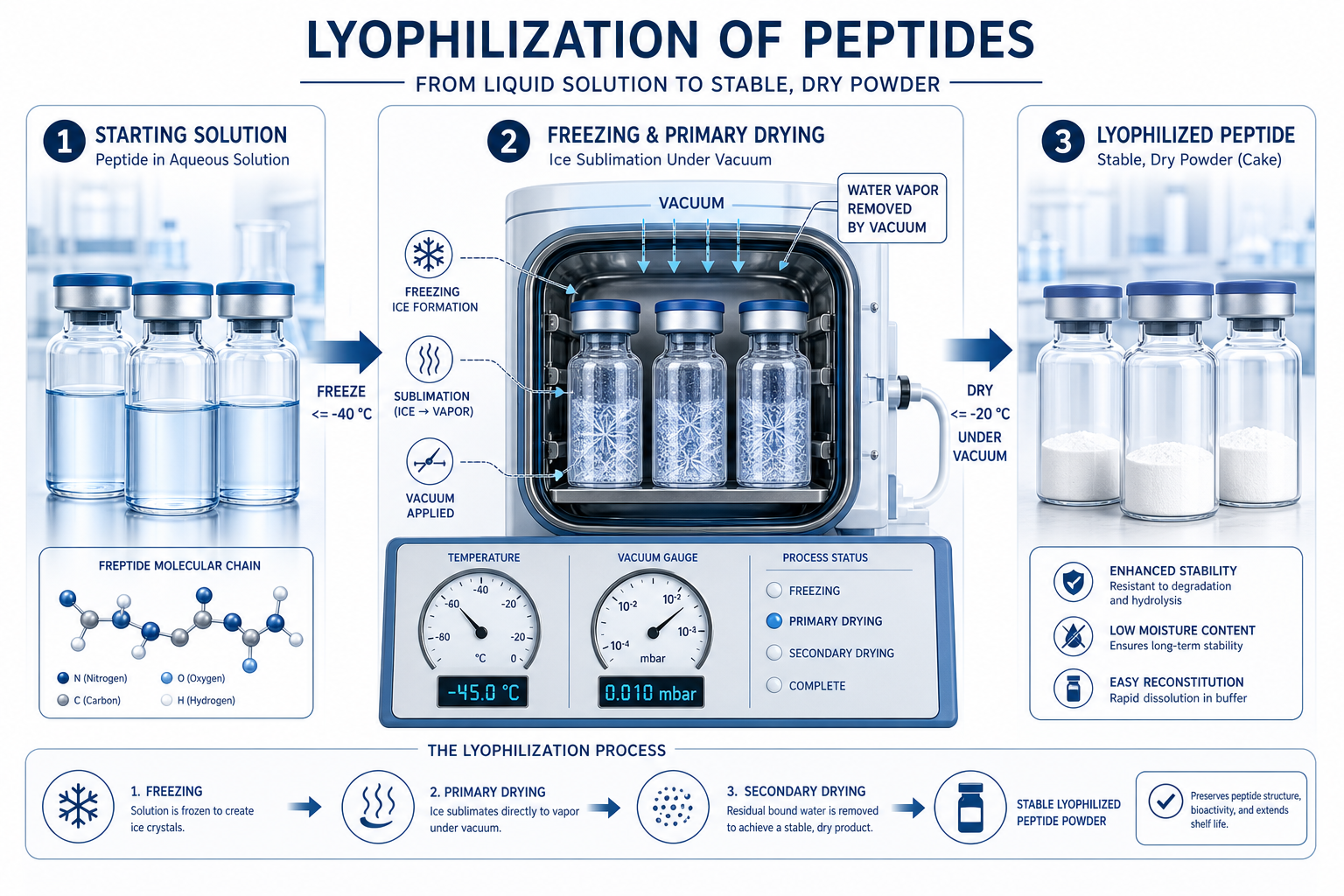
Lyophilized simply means freeze-dried. The word comes from the Greek “lyo” (to loosen) and “philos” (loving), but in practice it describes a dehydration process where a substance is first frozen solid, then placed under a strong vacuum so the ice turns directly into vapor, skipping the liquid stage entirely. What remains is a dry, porous solid, often appearing as a white powder or cake.
For peptides specifically, this means the amino acid chains are preserved in a dry matrix with minimal chemical activity. No water means no hydrolysis, no microbial growth, and a dramatically slower rate of oxidation.
Why Scientists Freeze-Dry Peptides Instead of Keeping Them Liquid
Peptides in liquid solution are chemically active and biologically vulnerable. Water acts as a medium for degradation reactions, including hydrolysis (where water molecules break peptide bonds), oxidation of sensitive amino acids like methionine and cysteine, and microbial contamination. Even refrigerated liquid peptides typically degrade meaningfully within days to a few weeks.
Lyophilization solves these problems by removing the water entirely. Key reasons researchers choose freeze-drying over liquid storage include:
- Hydrolysis prevention: No water means peptide bonds are not exposed to the primary agent that breaks them.
- Oxidation reduction: Dry environments slow oxidative degradation of sensitive residues.
- Microbial control: Bacteria and fungi cannot grow without moisture.
- Concentration consistency: A weighed powder gives more precise dosing than a solution that may have evaporated slightly.
“Lyophilization is not just a convenience, it is often the only practical way to preserve complex peptide sequences over meaningful timeframes.”
How Long Do Lyophilized Peptides Last Compared to Liquid
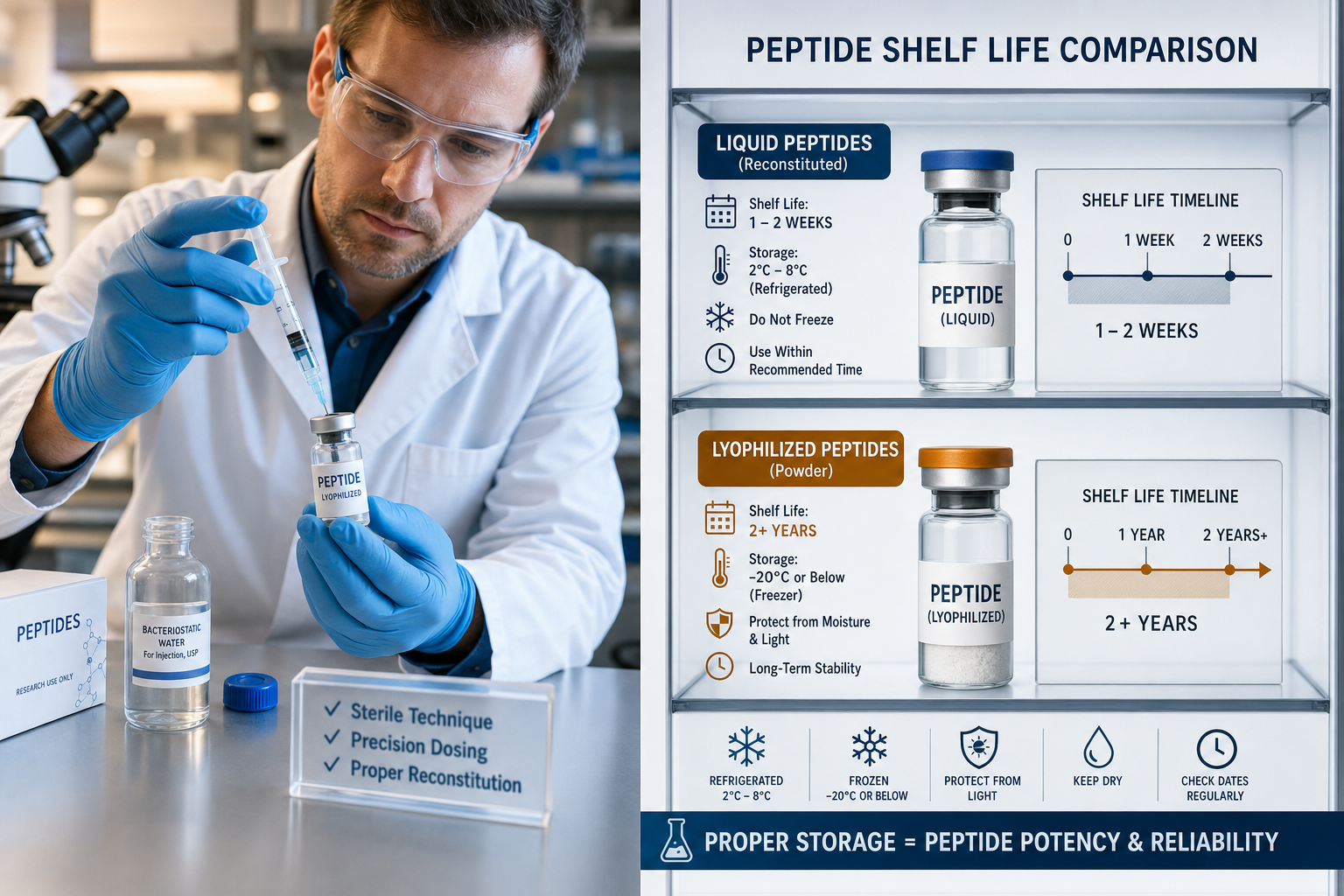
Lyophilized peptides stored at -20 degrees Celsius in a sealed, desiccated container can maintain stability for two years or longer, with some manufacturers citing shelf lives of up to five years for simple, non-oxidation-prone sequences. Liquid peptide solutions, even when refrigerated at 4 degrees Celsius, typically degrade within one to four weeks depending on the sequence and formulation.
Stability comparison at a glance:
| Form | Storage Condition | Estimated Shelf Life |
|---|---|---|
| Liquid solution | 4°C (refrigerated) | 1–4 weeks |
| Liquid solution | -20°C (frozen) | 3–6 months |
| Lyophilized powder | 4°C (sealed, dry) | 12–24 months |
| Lyophilized powder | -20°C (sealed, dry) | 2–5 years |
| Lyophilized powder | Room temp (sealed, dry) | 6–12 months (sequence-dependent) |
These are general estimates. Peptides containing methionine, cysteine, tryptophan, or glutamine are more prone to degradation and may have shorter shelf lives regardless of form.
What Is the Difference Between Lyophilized and Regular Peptides
“Regular” peptides in this context usually means either liquid-formulated peptides or crude peptide powders that have not been lyophilized. The biological activity of a peptide does not change because of lyophilization, the amino acid sequence and structure are preserved, not altered. The difference is entirely about physical state, stability, and handling.
- Lyophilized peptides: Dry powder, long shelf life, require reconstitution before use, higher manufacturing cost.
- Liquid peptides: Ready to use, shorter shelf life, more sensitive to temperature swings, lower upfront processing cost.
- Crude peptide powders: May or may not be lyophilized; “crude” refers to purity level, not drying method.
Choose lyophilized if the peptide needs to be stored for more than a few weeks, shipped without cold chain, or used in precise quantitative assays.
Is Lyophilized the Same as Powder Peptides
Not always, but often yes. Lyophilized peptides are always in powder or cake form, but not all peptide powders are lyophilized. Some peptide powders are produced by spray-drying, precipitation, or simple evaporation, methods that do not involve the freeze-vacuum cycle of true lyophilization.
Lyophilized powders tend to be more porous and reconstitute more easily than spray-dried or precipitated powders. When a supplier specifies “lyophilized,” it signals a controlled, validated drying process that preserves structural integrity more reliably than other drying methods.
How to Reconstitute Freeze-Dried Peptides
Reconstituting lyophilized peptides means adding a solvent to dissolve the dry powder back into a usable solution. The correct solvent depends on the peptide’s chemistry, and using the wrong one can cause aggregation or incomplete dissolution.
Step-by-step reconstitution process:
- Allow the sealed vial to reach room temperature before opening to prevent moisture condensation on the cold powder.
- Check the manufacturer’s recommended solvent (sterile water, phosphate-buffered saline, or dilute acetic acid are common choices).
- Add solvent slowly along the vial wall, not directly onto the powder cake, to avoid foaming.
- Gently swirl or roll the vial. Do not vortex vigorously, as shear force can disrupt peptide structure.
- If the peptide does not dissolve fully, try brief sonication in a water bath or adjust pH with a small amount of dilute acid or base.
- Use reconstituted peptides promptly or store according to the manufacturer’s guidance (typically at -20°C, used within 1–4 weeks).
Common mistake: Adding too much solvent at once and then being uncertain about final concentration. Always calculate the target concentration before adding solvent and add it in measured increments.
Are Lyophilized Peptides Better for Storage and Shipping
Yes, lyophilized peptides are significantly better for both storage and shipping. The dry powder form tolerates temperature fluctuations far better than liquid solutions, which means they can often be shipped at ambient temperature for short durations without cold packs, reducing logistics costs and complexity.
For international shipments or deliveries to facilities without reliable cold chain infrastructure, lyophilized peptides are the standard choice. Most commercial peptide suppliers ship lyophilized products with simple desiccant packs rather than dry ice, which simplifies customs handling and reduces the risk of degradation during transit delays.
Can Lyophilized Peptides Go Bad or Expire
Yes. Lyophilized peptides can degrade, particularly if storage conditions are compromised. The most common causes of degradation in lyophilized peptides are:
- Moisture intrusion: Even small amounts of humidity reintroduce the conditions for hydrolysis and microbial growth.
- Temperature abuse: Repeated freeze-thaw cycles or storage above recommended temperatures accelerate chemical degradation.
- Light exposure: UV light can oxidize aromatic amino acids like tryptophan and tyrosine.
- Oxygen exposure: Opening vials repeatedly without inert gas backfill allows oxidation to accumulate.
Most lyophilized peptides carry a manufacturer-assigned expiry date, typically 12 to 24 months from production. Sequences with oxidation-prone residues may have shorter stated shelf lives.
What Happens If You Don’t Store Lyophilized Peptides Correctly
Improper storage leads to measurable loss of purity and potency. A lyophilized peptide exposed to humidity may partially rehydrate, clump, and begin hydrolytic degradation. Visually, the powder may appear discolored, sticky, or collapsed rather than free-flowing and white.
Functionally, degraded peptides produce inconsistent assay results, reduced biological activity, and in some cases the formation of degradation byproducts that interfere with downstream experiments. For research use, this means wasted reagents and unreliable data. For clinical or pharmaceutical applications, it can mean failed quality control and product rejection.
Best storage practice: Store in sealed vials with desiccant, under inert gas if possible, at -20°C, away from light, and open only when needed.
Who Uses Freeze-Dried Peptides and Why
Lyophilized peptides are used across a wide range of fields where peptide stability and reproducibility are critical.
- Pharmaceutical manufacturers: Produce lyophilized peptide drug products (such as GLP-1 receptor agonists and oxytocin analogues) for clinical use.
- Vaccine developers: Use lyophilized peptide antigens for immunogenicity studies and peptide-based vaccine formulations.
- Academic and clinical researchers: Rely on lyophilized peptides for cell biology assays, receptor binding studies, and proteomics work.
- Diagnostic kit manufacturers: Incorporate lyophilized peptide standards into ELISA kits and immunoassay panels for consistent lot-to-lot performance.
- Cosmetic and nutraceutical formulators: Use lyophilized bioactive peptides (such as collagen-derived sequences) in products where shelf stability is a commercial requirement.
How Much Does Lyophilization Cost Compared to Regular Peptide Prep
Lyophilization adds meaningful cost to peptide production. The equipment (industrial freeze-dryers) is expensive to purchase and maintain, the process is time-consuming (a single lyophilization cycle can take 24 to 72 hours), and the process requires validation for pharmaceutical-grade applications.
As a rough estimate, lyophilization can add 10 to 30 percent to the cost of producing a peptide batch compared to delivering it as a liquid solution, depending on scale and equipment amortization. For small research quantities (milligram to gram scale), this premium is usually absorbed into the per-milligram price quoted by peptide synthesis suppliers.
The cost is generally justified because the extended shelf life reduces waste, simplifies quality control, and eliminates the need for expensive cold chain logistics.
Do Lyophilized Peptides Work as Well as Fresh Ones
When properly lyophilized and correctly reconstituted, freeze-dried peptides perform equivalently to freshly prepared liquid peptides in terms of biological activity. The lyophilization process does not alter the primary amino acid sequence, and well-optimized protocols preserve secondary structure in most cases.
The key qualifier is “properly.” Peptides that were degraded before lyophilization, or that experienced moisture exposure during storage, will not perform as well as fresh preparations. Quality lyophilization of a high-purity peptide, followed by correct storage and reconstitution, should yield a product indistinguishable in activity from a freshly synthesized liquid preparation.
What Peptides Are Usually Sold Lyophilized
The vast majority of commercially synthesized research peptides are sold in lyophilized form. This includes:
- Custom synthetic peptides from research suppliers (typically greater than 95 percent purity, lyophilized as standard)
- GLP-1 analogues (semaglutide, liraglutide precursors used in research)
- Peptide hormones (oxytocin, vasopressin, ACTH fragments)
- Antimicrobial peptides used in microbiological research
- Collagen-derived peptides for cosmetic and nutraceutical research
- Epitope peptides for immunology and vaccine research
- Neuropeptides and receptor ligands used in neuroscience studies
Peptides that are delivered as liquid formulations are typically short, highly stable sequences (two to five amino acids) or formulations where the end user needs immediate, ready-to-use solutions and the shelf life window is acceptable.
FAQ
What does lyophilized mean on a peptide label?
It means the peptide has been freeze-dried and is supplied as a dry powder. The moisture has been removed under vacuum after freezing to preserve stability. The peptide must be dissolved in an appropriate solvent before use.
Can lyophilized peptides be stored at room temperature?
Short-term storage at room temperature (below 25 degrees Celsius) in a sealed, desiccated container is acceptable for many lyophilized peptides for up to a few months. For long-term storage, -20 degrees Celsius is recommended.
How do I know if my lyophilized peptide has gone bad?
Signs of degradation include discoloration (yellowing or browning), a sticky or clumped texture instead of free-flowing powder, failure to dissolve properly upon reconstitution, or unexpected results in biological assays.
Does lyophilization change the peptide’s molecular weight or sequence?
No. Lyophilization is a physical drying process. It does not alter the amino acid sequence or molecular weight of the peptide.
Why do some lyophilized peptides come as a fluffy cake rather than a powder?
The porous cake structure is a normal result of the freeze-drying process. The ice crystal network leaves behind a fragile, sponge-like solid. This form actually reconstitutes quickly because of its high surface area. It is not a sign of poor quality.
Is it safe to reconstitute a lyophilized peptide with tap water?
No. Tap water contains minerals, chlorine, and microorganisms that can interfere with peptide stability and assay results. Always use sterile water for injection, HPLC-grade water, or the specific buffer recommended by the supplier.
Can lyophilized peptides be re-lyophilized after reconstitution?
Technically yes, but it is not recommended for research-grade materials. Each freeze-drying cycle introduces stress and potential for degradation or loss of material. Reconstitute only what is needed and store the remainder as powder.
What is the difference between lyophilized and air-dried peptides?
Air-drying exposes peptides to heat and oxygen, which can cause oxidation and structural damage. Lyophilization occurs at sub-zero temperatures under vacuum, which is far gentler and preserves peptide integrity much more effectively.
Conclusion
Lyophilized (freeze-dried) peptides represent the most reliable and widely adopted method for preserving peptide integrity across research, pharmaceutical, and commercial applications. The process removes water under vacuum at sub-zero temperatures, converting a chemically vulnerable liquid into a stable, long-lasting powder without altering the peptide’s biological identity.
Actionable next steps for researchers and buyers:
- When ordering peptides for experiments that will not begin immediately, always specify lyophilized form.
- Store lyophilized peptides at -20 degrees Celsius in sealed vials with desiccant until the day of use.
- Follow the supplier’s recommended reconstitution solvent and protocol precisely to ensure full dissolution and accurate concentration.
- Inspect powder appearance before reconstitution; discard any vials showing discoloration, clumping, or moisture intrusion.
- For high-value or sensitive sequences (those containing methionine, cysteine, or tryptophan), request a certificate of analysis confirming purity at the time of manufacture and note the stated expiry date.
Understanding lyophilized (freeze-dried) peptides, what that means and why it’s used, is foundational knowledge for anyone working with peptide-based materials. The small additional cost and the extra reconstitution step are minor compared to the stability, reproducibility, and logistical advantages that freeze-drying provides.
References
- Manning, M. C., Chou, D. K., Murphy, B. M., Payne, R. W., & Katayama, D. S. (2010). Stability of protein pharmaceuticals: an update. Pharmaceutical Research, 27(4), 544–575. https://doi.org/10.1007/s11095-009-0045-6
- Wang, W. (2000). Lyophilization and development of solid protein pharmaceuticals. International Journal of Pharmaceutics, 203(1–2), 1–60. https://doi.org/10.1016/S0378-5173(00)00423-3
- Carpenter, J. F., Pikal, M. J., Chang, B. S., & Randolph, T. W. (1997). Rational design of stable lyophilized protein formulations: some practical advice. Pharmaceutical Research, 14(8), 969–975. https://doi.org/10.1023/A:1012180707283
- Kasper, J. C., & Friess, W. (2011). The freezing step in lyophilization: physico-chemical fundamentals, freezing methods and consequences on process performance and quality attributes of biopharmaceuticals. European Journal of Pharmaceutics and Biopharmaceutics, 78(2), 248–263. https://doi.org/10.1016/j.ejpb.2011.03.010
Meta Title: Lyophilized Freeze-Dried Peptides: What It Means and Why It’s Used
Meta Description: Learn what lyophilized (freeze-dried) peptides are, why scientists use them, how long they last, how to reconstitute them, and how to store them correctly.
Tags: lyophilized peptides, freeze-dried peptides, peptide storage, peptide reconstitution, lyophilization process, peptide stability, pharmaceutical peptides, research peptides, peptide shelf life, freeze-drying science, peptide formulation, bioactive peptides
