
No products in the cart.
Last updated: July 1, 2026
Quick Answer
Molecular weight tells you the mass of a single peptide molecule, expressed in daltons (Da) or grams per mole (g/mol), and is used to calculate accurate dosing and confirm the correct compound was synthesized. Purity refers to the percentage of the total sample that is actually the intended peptide, with the remainder being synthesis byproducts, truncated sequences, or residual solvents. Together, these two specifications are the primary quality indicators on any peptide certificate of analysis (CoA).
Key Takeaways
- Molecular weight is the sum of all atomic masses in a peptide chain, measured in daltons (Da) or g/mol.
- Purity is expressed as a percentage and reflects how much of the sample is the correct peptide versus impurities.
- High-performance liquid chromatography (HPLC) is the standard method for measuring peptide purity.
- Mass spectrometry (MS) is used to confirm molecular weight and verify peptide identity.
- Peptides used in research typically require greater than 95% purity; clinical-grade peptides often require greater than 98%.
- Low purity can skew experimental results, cause unexpected biological responses, or make dosing calculations inaccurate.
- Molecular weight does not change after synthesis if the correct sequence was made, but synthesis errors can produce peptides with different masses.
- Purity can degrade over time if peptides are stored incorrectly, particularly when exposed to moisture, heat, or repeated freeze-thaw cycles.
- Always request a CoA that includes both HPLC purity data and MS confirmation before using any peptide.
What Is the Molecular Weight of a Peptide?
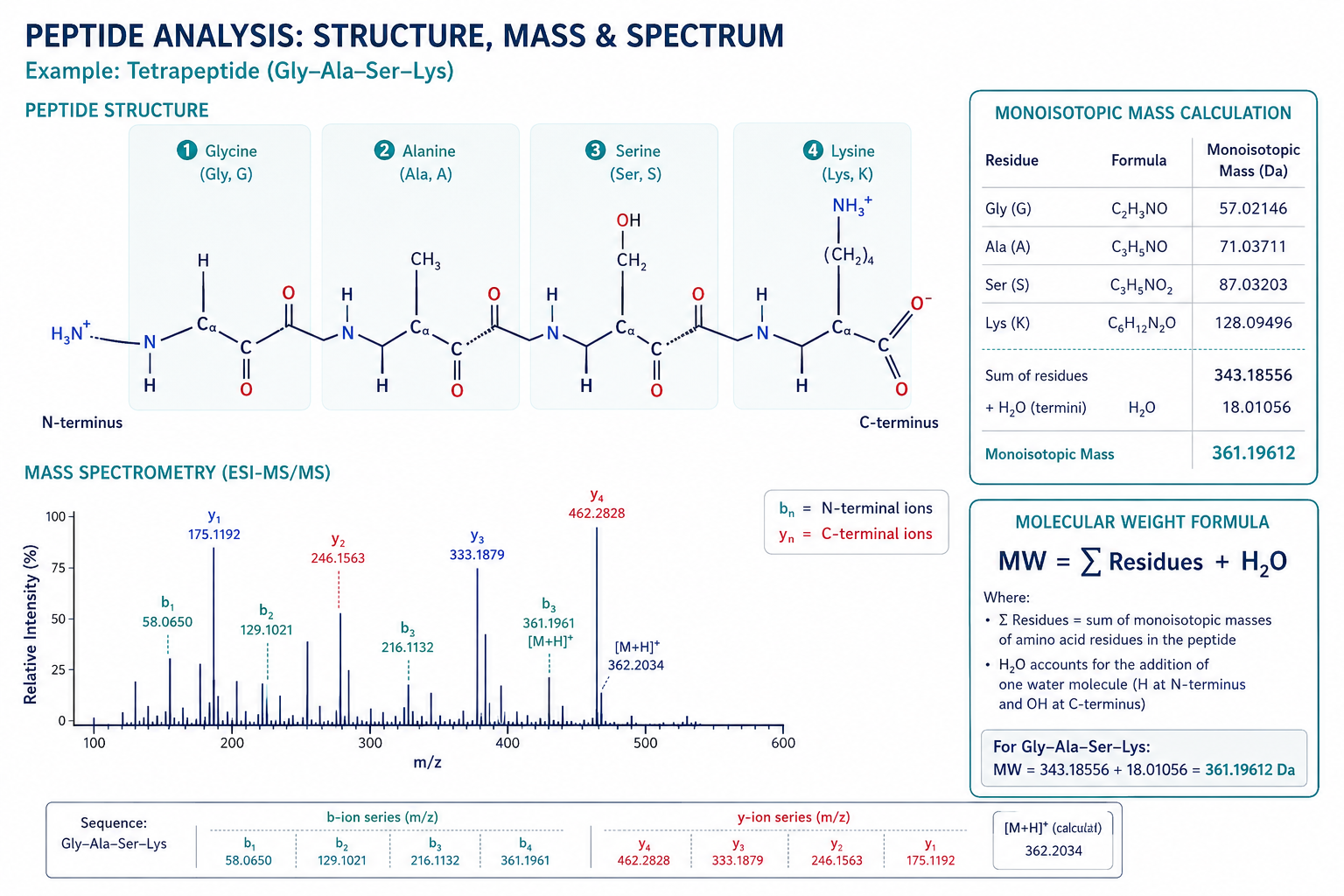
Molecular weight (MW) is the total mass of all atoms in a peptide molecule, measured in daltons (Da) or unified atomic mass units (u). For peptides, this value is calculated by adding the atomic masses of every atom in the sequence, accounting for the water molecule lost during each peptide bond formation.
Two types of molecular weight are commonly reported:
- Monoisotopic mass: Calculated using the exact mass of the most abundant isotope of each element. Used in high-resolution mass spectrometry.
- Average mass: Calculated using the weighted average atomic masses of all naturally occurring isotopes. More commonly listed on product datasheets and certificates of analysis.
For most practical purposes in research and peptide procurement, the average molecular weight is the relevant figure. A small peptide of 10 amino acids typically has a molecular weight in the range of 1,000 to 1,500 Da, while larger peptides can exceed 5,000 Da.
How Do You Calculate Peptide Molecular Weight?
Peptide molecular weight is calculated by summing the residue masses of each amino acid in the sequence, then adding the mass of one water molecule (18.02 Da) to account for the free N-terminus and C-terminus.
The basic formula:
MW = Sum of all amino acid residue masses + 18.02 Da (for H2O)
Each amino acid has a known residue mass. For example:
- Glycine (G): 57.02 Da
- Alanine (A): 71.04 Da
- Leucine (L): 113.08 Da
Example: A tripeptide Gly-Ala-Leu would have an estimated MW of 57.02 + 71.04 + 113.08 + 18.02 = 259.16 Da.
In practice, researchers use online peptide calculators or software tools to handle this automatically, especially for longer sequences or peptides with modifications such as disulfide bonds, phosphorylation, or PEGylation, all of which add or subtract mass.
Common mistake: Forgetting to account for post-translational modifications or protecting groups that were not fully removed during synthesis. These can add unexpected mass and cause a mismatch between the theoretical and observed MW on the mass spectrum.
Why Does Molecular Weight Matter for Peptides?
Molecular weight is essential for accurate molar dosing, identity verification, and understanding a peptide’s physical behavior. Without a confirmed MW, a researcher cannot reliably convert between mass (milligrams) and moles, which directly affects dose-response experiments.
Key reasons MW matters:
- Dosing accuracy: To prepare a 1 mM solution, you need to know the exact MW to calculate how many milligrams to dissolve per milliliter.
- Identity confirmation: If the observed MW from mass spectrometry matches the theoretical MW, this confirms the correct sequence was synthesized.
- Predicting behavior: Higher MW peptides tend to have lower membrane permeability and different solubility profiles compared to smaller peptides.
Decision rule: If the MS-confirmed MW deviates by more than 1 Da from the theoretical value, the batch should be rejected or investigated for synthesis errors before use.
What Affects Peptide Molecular Weight?
The molecular weight of a peptide is determined by its amino acid sequence and any chemical modifications. Several factors can cause the observed MW to differ from the theoretical value.
- Sequence errors during synthesis: Missed couplings or deletions produce truncated peptides with lower MW.
- Chemical modifications: Acetylation, amidation, phosphorylation, or PEGylation all change MW predictably.
- Oxidation: Unintended oxidation of methionine or cysteine residues adds 16 Da per oxidation event.
- Incomplete deprotection: Residual protecting groups from solid-phase synthesis add mass.
- Salt forms: Peptides supplied as trifluoroacetate (TFA) or acetate salts have different net weights than the free base form. This is relevant when calculating the actual peptide content by mass.
Does molecular weight change during peptide synthesis? The target peptide’s MW is fixed by its sequence, but synthesis errors or modifications can produce molecules with different masses. Mass spectrometry catches these discrepancies before a product ships.
What Does Purity Mean for Peptides?
Peptide purity is the percentage of the total sample that consists of the intended, full-length peptide sequence. A purity of 95% means that 95% of the material is the correct peptide and 5% is made up of impurities such as deletion sequences, truncated fragments, oxidized variants, or residual reagents.
Purity is not a single fixed number across all applications. The required purity depends entirely on how the peptide will be used.
How Is Peptide Purity Measured?
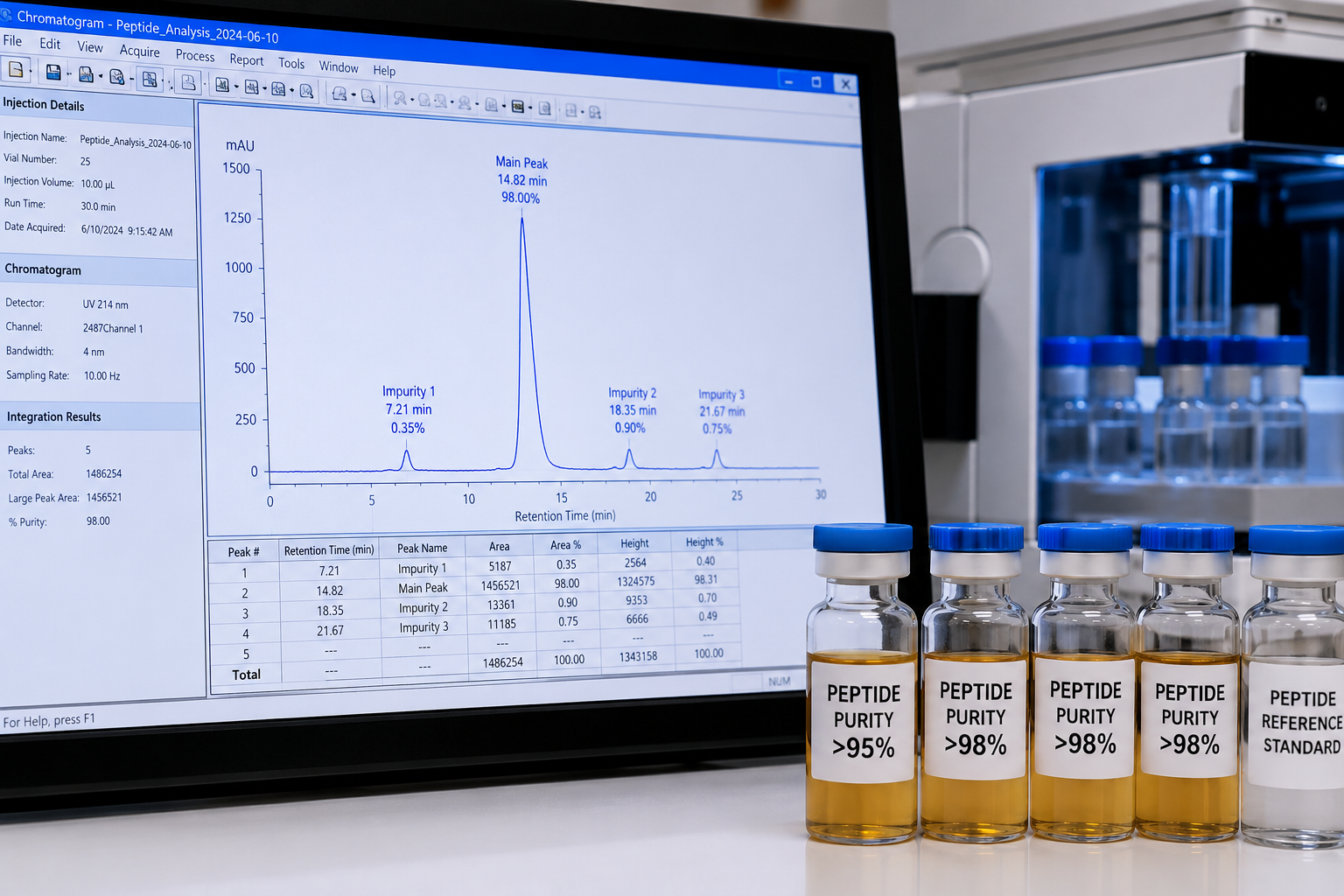
Reversed-phase HPLC (RP-HPLC) is the standard method for measuring peptide purity. The peptide sample is injected into a column, separated by hydrophobicity, and detected by UV absorbance, typically at 214 nm or 220 nm, which detects the peptide bond.
The purity percentage is calculated as:
Purity (%) = (Area of target peak / Total area of all peaks) x 100
Other methods used alongside HPLC:
- Mass spectrometry (MS): Confirms identity by matching observed MW to theoretical MW. MS does not directly measure purity percentage but identifies what impurities are present.
- Amino acid analysis (AAA): Quantifies the exact composition of amino acids; used for high-precision applications.
- Nuclear magnetic resonance (NMR): Used for structural confirmation in specialized research settings.
Important distinction: HPLC purity reflects the area percentage under the UV curve. It assumes all components absorb equally at the detection wavelength, which is not always true. For critical applications, multiple analytical methods should be used together.
What Is the Difference Between Peptide Purity Percentages?
Different purity grades serve different purposes, and choosing the wrong grade wastes money or compromises results.
| Purity Grade | Typical Use Case |
|---|---|
| Greater than 70% | Preliminary screening, non-quantitative assays |
| Greater than 85% | General research where exact dose is less critical |
| Greater than 95% | Standard research, cell-based assays, animal studies |
| Greater than 98% | Clinical research, in vivo studies, reference standards |
| Greater than 99% | Pharmaceutical manufacturing, regulatory submissions |
Choose greater than 95% if you are running dose-response curves, receptor binding assays, or any experiment where the impurity profile could confound results. Choose greater than 98% if the peptide will be administered to animals or humans, or if you need a reference standard for analytical work.
How Pure Does a Peptide Need to Be?
The required purity depends on the application. For most academic research applications, greater than 95% purity is the accepted standard. For in vivo studies or any work intended to support regulatory filings, greater than 98% is the minimum acceptable threshold.
Practical guidance by use case:
- Antibody production: Greater than 85% is often sufficient for immunization.
- ELISA coating antigen: Greater than 90% is generally adequate.
- Cell-based functional assays: Greater than 95% to avoid cytotoxic impurities confounding results.
- Animal pharmacology studies: Greater than 98% to minimize off-target effects from impurities.
- Clinical trial material: Greater than 99%, with full characterization of all impurities.
Can Peptide Purity Affect Results, and What Happens If Purity Is Low?
Yes, low purity directly affects experimental outcomes. Impurities in a peptide sample can produce false-positive biological activity, mask the true activity of the target peptide, cause cytotoxicity in cell assays, or make it impossible to determine which component is responsible for an observed effect.
Specific consequences of low purity:
- Inaccurate EC50 or IC50 values: If 10% of the sample is a biologically active truncated fragment, the apparent potency of the intended peptide will be skewed.
- Cytotoxicity artifacts: Residual TFA or synthesis reagents at high concentrations can kill cells independently of the peptide.
- Irreproducible results: Batch-to-batch variation in impurity profiles makes it difficult to replicate experiments across different lots.
- Dosing errors: If purity is 80% but assumed to be 100%, every dose is 20% lower than intended.
How to Check Peptide Molecular Weight and Purity
Every reputable peptide supplier provides a certificate of analysis (CoA) for each batch. Researchers should verify the following before use:
- Confirm the HPLC chromatogram is included, not just a purity number. The chromatogram should show a dominant single peak with minor or absent secondary peaks.
- Check the MS data to confirm the observed mass matches the theoretical MW within 1 Da (or within the instrument’s stated accuracy).
- Verify the purity method used. Area percent by UV at 214 nm is standard; be cautious if the method is not specified.
- Check the lot number on the CoA matches the lot number on the vial.
- Review storage conditions on the CoA. Peptides stored improperly before shipping may have degraded purity even if the CoA shows high values.
Edge case: Some suppliers report purity by HPLC at 220 nm rather than 214 nm. The two wavelengths can give slightly different purity values for the same sample because different functional groups absorb differently at each wavelength. When comparing purity values across suppliers, confirm which wavelength was used.
FAQ
What unit is peptide molecular weight expressed in?
Peptide molecular weight is expressed in daltons (Da) or grams per mole (g/mol). These units are numerically equivalent for molecular-scale calculations. Larger peptides may be expressed in kilodaltons (kDa).
Is molecular weight the same as molecular mass for peptides?
In common usage, yes. Molecular mass and molecular weight are used interchangeably for peptides, though technically molecular weight is dimensionless and molecular mass is expressed in daltons. The distinction rarely matters in practical peptide work.
What is a good purity level for research peptides?
Greater than 95% purity is the standard for most research applications. For in vivo or clinical work, greater than 98% is the accepted minimum.
Can a peptide have the correct purity but the wrong molecular weight?
Yes. A sample could be 98% pure but contain the wrong peptide if a synthesis error produced a sequence with a different mass. This is why both HPLC purity and MS confirmation are required together.
Does purity degrade over time?
Yes. Peptides can degrade through hydrolysis, oxidation, or aggregation, especially when stored in solution, exposed to moisture, or subjected to repeated freeze-thaw cycles. Lyophilized (freeze-dried) peptides stored at -20 degrees Celsius or colder are most stable.
Why do some peptides have lower purity grades available?
Longer peptides (greater than 30 amino acids) are inherently harder to synthesize at high purity because each coupling step has a small error rate that compounds with sequence length. Achieving greater than 98% purity for a 50-residue peptide requires additional purification steps and is significantly more expensive.
What is TFA content and how does it relate to purity?
TFA (trifluoroacetic acid) is a reagent used in solid-phase peptide synthesis that can remain as a counter-ion in the final product. It is not counted as an impurity in HPLC purity measurements but adds to the total mass of the sample. High TFA content means the actual peptide content by mass is lower than the labeled amount.
How do I use molecular weight to prepare a peptide solution?
Use the formula: mass (mg) / (molecular weight (g/mol) x desired volume (L)) x 1000 = concentration (mM). Most peptide suppliers include a reconstitution guide on the CoA.
Can two peptides have the same molecular weight but different sequences?
Yes. These are called isobaric peptides. Mass spectrometry alone cannot distinguish them; sequencing by MS/MS fragmentation is needed to confirm the exact sequence.
What does “net peptide content” mean on a CoA?
Net peptide content corrects for the presence of water, TFA, and other counter-ions in the lyophilized powder to give the actual percentage of pure peptide by mass. A peptide with 95% HPLC purity may have a net peptide content of only 75-80% by weight once moisture and salt content are accounted for.
Conclusion
Understanding what “molecular weight” and “purity” mean for peptides is not a technical formality. These two specifications determine whether a peptide is correctly identified, accurately dosed, and fit for its intended purpose. A high-purity peptide with a confirmed MW is the foundation of reproducible, credible research.
Actionable next steps:
- Always request a CoA with both HPLC chromatogram data and MS confirmation before accepting a peptide batch.
- Match the purity grade to the application: greater than 95% for standard research, greater than 98% for in vivo work.
- Use the peptide’s MW to calculate molar concentrations accurately, and account for TFA salt form and net peptide content when weighing out material.
- Store lyophilized peptides at -20 degrees Celsius or below, protected from moisture, to preserve purity over time.
- If results are inconsistent across experiments, request a fresh purity analysis on stored peptide stocks before assuming the biology is at fault.
References
- Amblard, M., Fehrentz, J. A., Martinez, J., & Subra, G. (2006). Methods and protocols of modern solid phase peptide synthesis. Molecular Biotechnology, 33(3), 239-254. https://doi.org/10.1385/MB:33:3:239
- Coin, I., Beyermann, M., & Bienert, M. (2007). Solid-phase peptide synthesis: from standard procedures to the synthesis of difficult sequences. Nature Protocols, 2(12), 3247-3256. https://doi.org/10.1038/nprot.2007.454
- Roepstorff, P., & Fohlman, J. (1984). Proposal for a common nomenclature for sequence ions in mass spectra of peptides. Biomedical Mass Spectrometry, 11(11), 601. https://doi.org/10.1002/bms.1200111109
- United States Pharmacopeia (USP). (2023). General Chapter <1> Injections and Implanted Drug Products. USP-NF. https://www.usp.org
Meta Title: Peptide Molecular Weight and Purity Explained | 2026 Guide
Meta Description: Learn what molecular weight and purity mean for peptides, how they are measured, why they matter for research, and how to read a certificate of analysis correctly.
Tags: peptide purity, molecular weight, peptide synthesis, HPLC analysis, mass spectrometry, certificate of analysis, peptide quality, research peptides, peptide dosing, amino acid sequence, peptide impurities, solid-phase peptide synthesis
