
No products in the cart.
Last updated: July 1, 2026
Quick Answer: Peptides and proteins are both made of amino acids linked together, but size separates them. A peptide contains fewer than 50 amino acids, while a protein contains 50 or more and folds into a complex three-dimensional structure. This size difference drives nearly every practical distinction between the two, from how the body absorbs them to what roles they play in health, muscle growth, and skincare.
Key Takeaways
- Peptides are short chains of amino acids (typically 2 to 49); proteins are longer chains (50 or more) that fold into functional 3D shapes.
- There is no universally agreed single cutoff number, but 50 amino acids is the most widely cited threshold in biochemistry literature.
- Proteins perform structural and enzymatic roles; peptides often act as signaling molecules, hormones, or targeted messengers.
- Peptides are generally absorbed faster than intact proteins because they require less digestion.
- Peptide supplements and protein powders serve different goals: peptides target specific biological signals, while protein powders primarily supply raw amino acid material for muscle repair and growth.
- Neither is universally “better.” The right choice depends on the goal, whether that is muscle building, skin health, hormone support, or general nutrition.
- Peptides are not simply broken-down proteins, though some peptides are produced when proteins are digested.
- Cost matters: therapeutic peptides and specialty peptide supplements typically cost significantly more than standard protein powders.
Peptide vs. Protein Definition: What Are They, Exactly?
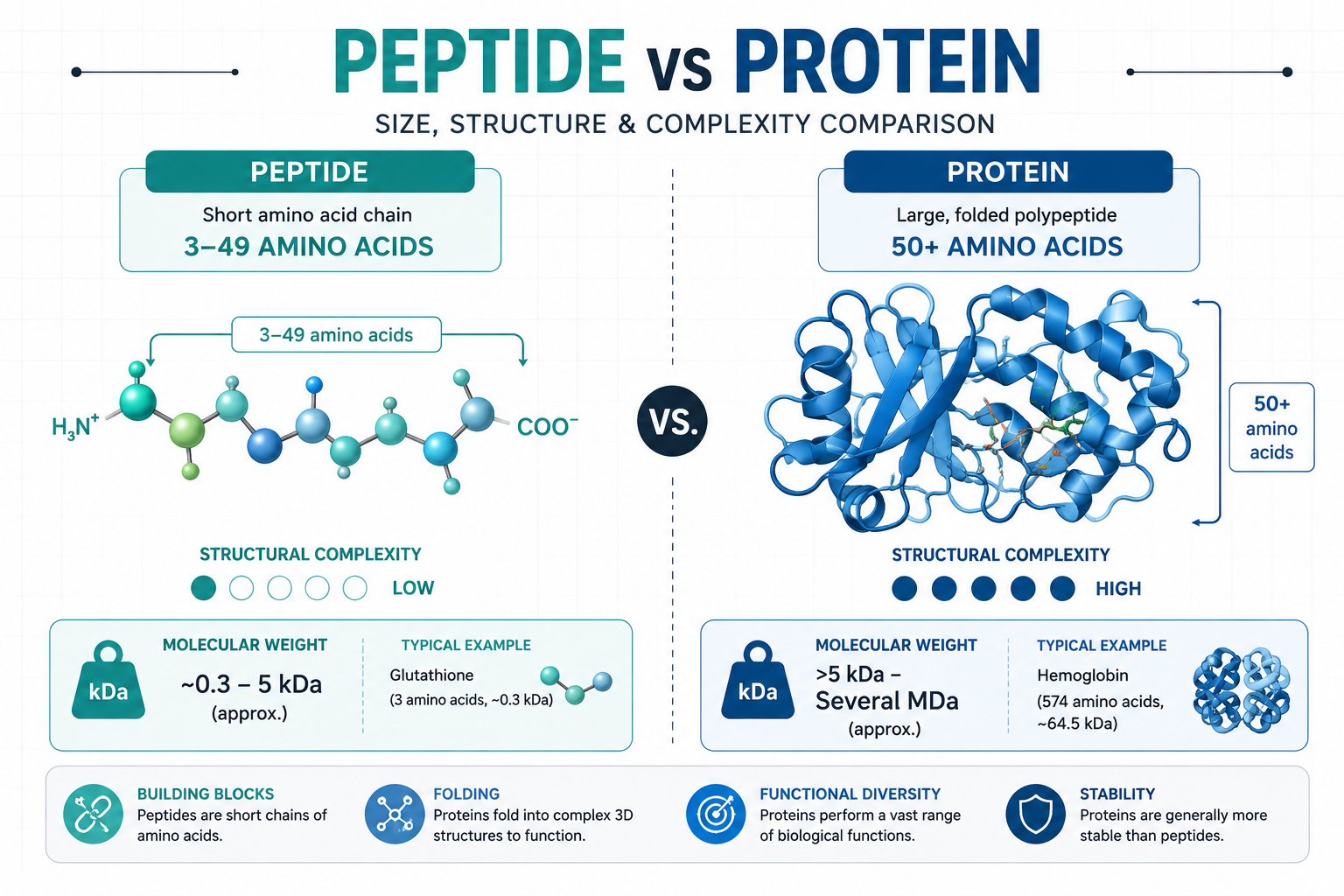
Peptides and proteins are both polymers of amino acids connected by peptide bonds, but they differ in chain length and structural complexity. A peptide is a short chain of 2 to roughly 49 amino acids. A protein is a longer chain, generally 50 or more amino acids, that folds into a specific three-dimensional shape critical to its function.
The word “peptide” comes from the Greek peptos, meaning digested. Proteins derive their name from the Greek proteios, meaning primary or first, reflecting how central they are to biological life. Both molecules are built from the same 20 standard amino acids, connected in sequence by covalent peptide bonds.
Key vocabulary:
- Dipeptide: 2 amino acids
- Tripeptide: 3 amino acids
- Oligopeptide: 2 to 20 amino acids
- Polypeptide: 20 to 49 amino acids (definitions vary by source)
- Protein: 50 or more amino acids with defined tertiary structure
How Many Amino Acids Make a Peptide vs. Protein?
The most widely used boundary is 50 amino acids, but biochemists acknowledge this line is somewhat arbitrary. Chains below 50 amino acids are called peptides; chains at or above 50 are typically called proteins.
Some sources place the cutoff at 40 or even 100 amino acids, and the distinction can blur in practice. For example, insulin, one of the best-known biological molecules, contains 51 amino acids and is classified as a protein despite sitting right at the boundary. What matters more than an exact number is whether the chain folds into a stable, functional three-dimensional structure, which proteins do and most peptides do not.
“The 50-amino-acid threshold is a practical convention, not a hard biochemical law. What truly defines a protein is its ability to fold into a stable, functional conformation.”
Peptide vs. Protein Structure Differences
Proteins fold. Peptides generally do not. This structural difference is the root cause of nearly every functional distinction between the two.
Protein structure is described in four levels:
| Level | Description | Example |
|---|---|---|
| Primary | Amino acid sequence | The order of building blocks |
| Secondary | Local folding (alpha helices, beta sheets) | Coiled or sheet-like segments |
| Tertiary | Full 3D shape of a single chain | Globular enzyme shape |
| Quaternary | Multiple protein chains assembled together | Hemoglobin (4 chains) |
Peptides typically only have primary structure and sometimes partial secondary structure. Because they are small and flexible, they do not hold a fixed shape the way proteins do. This makes peptides more mobile in the body and easier to synthesize in a lab, but it also means they cannot perform the complex mechanical or enzymatic tasks that proteins handle.
When Does a Peptide Become a Protein?
A peptide becomes a protein when its amino acid chain grows long enough to fold into a stable three-dimensional structure, generally at around 50 amino acids. Below that threshold, the chain typically lacks the mass and complexity needed to maintain a consistent shape on its own.
The folding process is what grants proteins their function. An enzyme’s active site, an antibody’s binding region, a receptor’s signaling pocket, all of these depend on precise three-dimensional geometry. Peptides, being too short to fold meaningfully, cannot replicate this. So the transition from peptide to protein is less about a specific number and more about the emergence of structural complexity.
Peptide vs. Protein Function in the Body
Proteins are the workhorses of the body. They build muscle tissue, catalyze chemical reactions, transport oxygen, regulate gene expression, and form structural materials like collagen and keratin. Peptides, by contrast, act more like messengers and modulators.
What proteins do:
- Structural support (collagen, elastin, keratin)
- Enzyme catalysis (digestive enzymes, metabolic enzymes)
- Immune defense (antibodies)
- Oxygen transport (hemoglobin)
- Cell signaling receptors
What peptides do:
- Hormonal signaling (insulin, glucagon, oxytocin)
- Antimicrobial defense (defensins)
- Pain modulation (endorphins)
- Skin repair and collagen stimulation
- Appetite regulation (ghrelin, leptin fragments)
Peptides often act faster and more specifically than proteins because their small size allows them to reach target receptors quickly and bind with high selectivity.
Are Peptides Easier to Absorb Than Proteins?
Yes, peptides are generally absorbed faster and more efficiently than intact proteins. The digestive system must break proteins down into smaller fragments before absorption can occur, which takes time. Peptides, especially di- and tripeptides, can be absorbed directly through intestinal transporters (notably the PEPT1 transporter) without full digestion.
Research published in the Journal of Nutrition (Adibi, 1997) established that small peptides are absorbed via dedicated intestinal transport systems that operate independently of free amino acid uptake pathways, meaning the body can take them up quickly and efficiently.
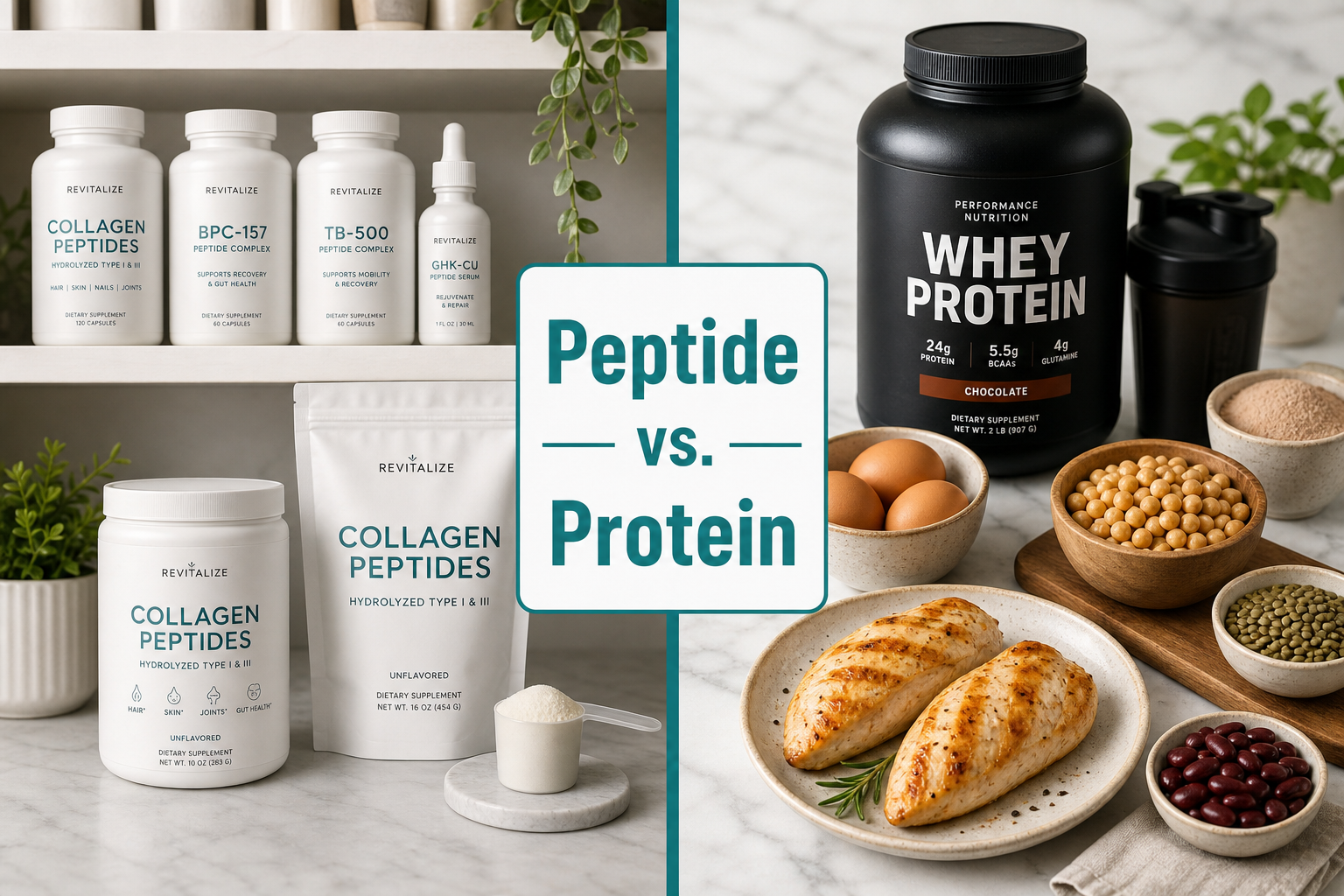
Practical implication: Collagen peptide supplements, for example, are hydrolyzed (pre-broken down) specifically to improve absorption speed compared to intact collagen protein.
Are Peptides Just Broken-Down Proteins?
Not exactly. Some peptides are produced when proteins are digested, but many peptides are synthesized independently by the body or manufactured in a lab without ever being part of a larger protein.
For example, the hormone oxytocin is a 9-amino-acid peptide synthesized directly by neurons in the hypothalamus. It was never a fragment of a larger protein. Similarly, many pharmaceutical peptides are built from scratch using chemical synthesis. So while digestion does produce peptides from proteins, the two categories are not simply “whole” versus “broken down.”
Peptide Supplements vs. Protein Powder: Which Is Better?
They serve different purposes, so “better” depends entirely on the goal. Protein powders supply a broad pool of amino acids to support muscle repair, recovery, and general nutrition. Peptide supplements target specific biological pathways with precision.
Choose protein powder if:
- The goal is general muscle building or meeting daily protein intake targets
- Budget is a primary concern
- A broad nutritional foundation is the priority
Choose peptide supplements if:
- The goal is specific: skin collagen support, joint recovery, or hormone-related signaling
- A targeted biological effect is needed beyond raw amino acid supply
- A healthcare provider has recommended a specific peptide for a clinical purpose
Neither replaces the other. Many people use both.
Peptide vs. Protein for Muscle Growth
Protein is the foundation of muscle growth. Muscle tissue is built primarily from structural proteins, and the body needs a steady supply of amino acids, particularly leucine, to trigger muscle protein synthesis. Protein powders (whey, casein, plant-based blends) are well-supported by decades of sports nutrition research for this purpose.
Peptides play a supporting role. Certain peptides, such as BPC-157 (studied for tissue repair) and growth hormone-releasing peptides (GHRPs), are investigated for their ability to support recovery and anabolic signaling. However, most of these are still in research phases, and their use outside clinical settings carries regulatory and safety considerations.
For straightforward muscle building, high-quality dietary protein remains the primary tool.
Peptide vs. Protein for Skin Health
Peptides have a clear advantage for topical skin applications. Collagen is a protein too large to penetrate the skin barrier when applied directly. Collagen peptides, being much smaller, can penetrate more effectively and signal skin cells (fibroblasts) to produce more collagen.
Commonly studied skin peptides include:
- Matrixyl (palmitoyl pentapeptide-4): Studied for wrinkle reduction and collagen stimulation
- Argireline (acetyl hexapeptide-3): Investigated for reducing expression lines
- Copper peptides (GHK-Cu): Researched for wound healing and skin regeneration
For internal skin support, collagen protein hydrolysate (essentially collagen broken into peptides) taken orally has shown promise in clinical studies for improving skin elasticity and hydration (Proksch et al., Skin Pharmacology and Physiology, 2014).
Peptide vs. Protein Digestion Time
Intact proteins typically take 2 to 6 hours to digest fully, depending on the source. Whey protein is among the fastest (roughly 1 to 2 hours); casein is slower (up to 7 hours). Peptides, particularly hydrolyzed forms, digest and absorb in under an hour in many cases because the enzymatic work is already partially done.
This speed difference matters most in post-workout contexts, where faster amino acid delivery may support recovery, and in clinical nutrition, where rapid absorption is needed for patients with compromised digestion.
Who Should Take Peptides Instead of Protein?
Most healthy adults do not need peptide supplements if they are meeting protein intake through diet and standard protein supplements. Peptide supplements are most relevant for:
- People with specific skin, joint, or connective tissue goals
- Individuals with digestive conditions that impair protein breakdown
- Athletes or patients under medical supervision exploring recovery-focused peptides
- Those addressing specific hormonal or signaling deficiencies under clinical guidance
People who simply want to build muscle, lose weight, or improve general health will typically get more value from optimizing total dietary protein intake before adding specialty peptide products.
Peptide vs. Protein Cost Comparison
Protein powders are significantly less expensive than most peptide supplements. A month’s supply of whey protein typically costs $30 to $60 (USD, 2026 estimates based on retail market ranges). Specialty collagen peptide supplements range from $40 to $80 per month. Pharmaceutical-grade or research peptides can cost hundreds of dollars per cycle, and many are not approved for general consumer use.
Cost decision rule: If the budget is limited and the goal is general nutrition or muscle support, protein powder offers far better value per gram of amino acids. Peptide supplements justify their higher cost only when targeting a specific biological outcome that protein alone cannot address.
Conclusion
Understanding peptide vs. protein: what’s the difference comes down to three things: size, structure, and function. Peptides are short, flexible chains that act as precise biological messengers. Proteins are longer, folded structures that perform the body’s heavy structural and enzymatic work. Neither is superior in absolute terms, and they often work together in the body.
Actionable next steps:
- Clarify your goal first. Muscle building and general nutrition call for adequate dietary protein. Targeted outcomes like skin collagen support or joint recovery may warrant a specific peptide supplement.
- Check the evidence. Not all peptide supplements have strong clinical backing. Look for products with published human trial data, not just in-vitro or animal studies.
- Consult a healthcare provider before starting any therapeutic peptide, particularly injectable or pharmaceutical-grade products.
- Prioritize whole food protein as the foundation. Supplements, whether peptide or protein, work best on top of a solid dietary base.
- Compare cost per outcome. Peptide supplements are expensive. Confirm the specific benefit justifies the cost before committing long-term.
Frequently Asked Questions
Q: What is the simplest way to define the difference between a peptide and a protein?
A: A peptide is a short chain of amino acids (under 50), while a protein is a longer chain (50 or more) that folds into a three-dimensional shape. Size and structural complexity are the key differences.
Q: Is collagen a peptide or a protein?
A: Collagen is a protein. Collagen peptides are the hydrolyzed (broken-down) form sold in supplements, made by breaking the full collagen protein into smaller, more absorbable fragments.
Q: Can the body make peptides on its own?
A: Yes. The body synthesizes many peptides directly, including hormones like insulin, oxytocin, and glucagon. These are not derived from larger proteins.
Q: Are protein shakes the same as peptide supplements?
A: No. Protein shakes supply intact or partially digested protein to meet amino acid needs. Peptide supplements deliver specific short-chain molecules designed to trigger targeted biological responses.
Q: Do peptides build muscle as well as protein?
A: Not in the same way. Protein provides the amino acid building blocks muscle tissue requires. Certain peptides may support recovery or hormonal signaling, but they do not replace dietary protein for muscle synthesis.
Q: Are peptide supplements safe?
A: Many commercially available peptide supplements (such as collagen peptides) have strong safety records. However, some research peptides sold online are not approved for human use and carry unknown risks. Always verify regulatory status and consult a healthcare provider.
Q: How do I know if a peptide supplement is worth buying?
A: Look for human clinical trial data, not just animal studies. Check that the specific peptide in the product matches the one studied in research, and verify the dose aligns with what was tested.
Q: Is whey protein a peptide?
A: Whey protein is a protein. Some whey products are “hydrolyzed,” meaning partially broken into peptides to improve absorption speed, but standard whey protein concentrate and isolate are intact proteins.
References
- Adibi, S. A. (1997). The oligopeptide transporter (Pept-1) in human intestine: Biology and function. Gastroenterology, 113(1), 332-340.
- Proksch, E., Segger, D., Degwert, J., Schunck, M., Zague, V., & Oesser, S. (2014). Oral supplementation of specific collagen peptides has beneficial effects on human skin physiology: A double-blind, placebo-controlled study. Skin Pharmacology and Physiology, 27(1), 47-55.
- Nelson, D. L., & Cox, M. M. (2017). Lehninger Principles of Biochemistry (7th ed.). W. H. Freeman.
- Alberts, B., Johnson, A., Lewis, J., Morgan, D., Raff, M., Roberts, K., & Walter, P. (2014). Molecular Biology of the Cell (6th ed.). Garland Science.
Meta Title: Peptide vs. Protein: What’s the Difference? (2026 Guide)
Meta Description: Learn the key differences between peptides and proteins, from amino acid count and structure to absorption, muscle growth, skin health, and supplement costs.
Tags: peptide vs protein, peptides, protein supplements, amino acids, collagen peptides, muscle growth, skin health, protein powder, peptide supplements, biochemistry, sports nutrition, collagen protein
