
No products in the cart.
Last updated: July 1, 2026
Quick Answer: Peptides are synthesized by chemically joining amino acids one at a time in a specific sequence. The dominant method is solid-phase peptide synthesis (SPPS), where a growing peptide chain is anchored to an insoluble resin bead and amino acids are added sequentially through repeated cycles of deprotection and coupling. The process ends with cleavage of the finished peptide from the resin, followed by purification.
Key Takeaways
- Solid-phase peptide synthesis builds peptide chains from the C-terminus to the N-terminus, one amino acid at a time, while the chain remains attached to a solid resin support.
- The two main SPPS strategies are Fmoc (base-labile protection) and Boc (acid-labile protection); Fmoc is the more widely used method in modern labs.
- Each synthesis cycle involves three core steps: deprotection, coupling, and washing.
- Cleavage from the resin and side-chain deprotection are performed simultaneously using a cocktail of trifluoroacetic acid (TFA) and scavengers.
- HPLC is the standard method for purifying crude peptides after synthesis; mass spectrometry confirms identity.
- Automated peptide synthesizers can complete a 20-residue peptide in under 24 hours.
- Peptides longer than 50 residues become increasingly difficult to synthesize by SPPS alone due to accumulating coupling errors.
- Synthesis costs vary widely: academic core facilities may charge $5 to $30 per residue, while commercial suppliers price finished peptides by purity and length.
- Home synthesis is not practical; SPPS requires specialized reagents, solvents, and equipment that are only safely managed in a properly equipped laboratory.
What Is Solid-Phase Peptide Synthesis and How Does It Work
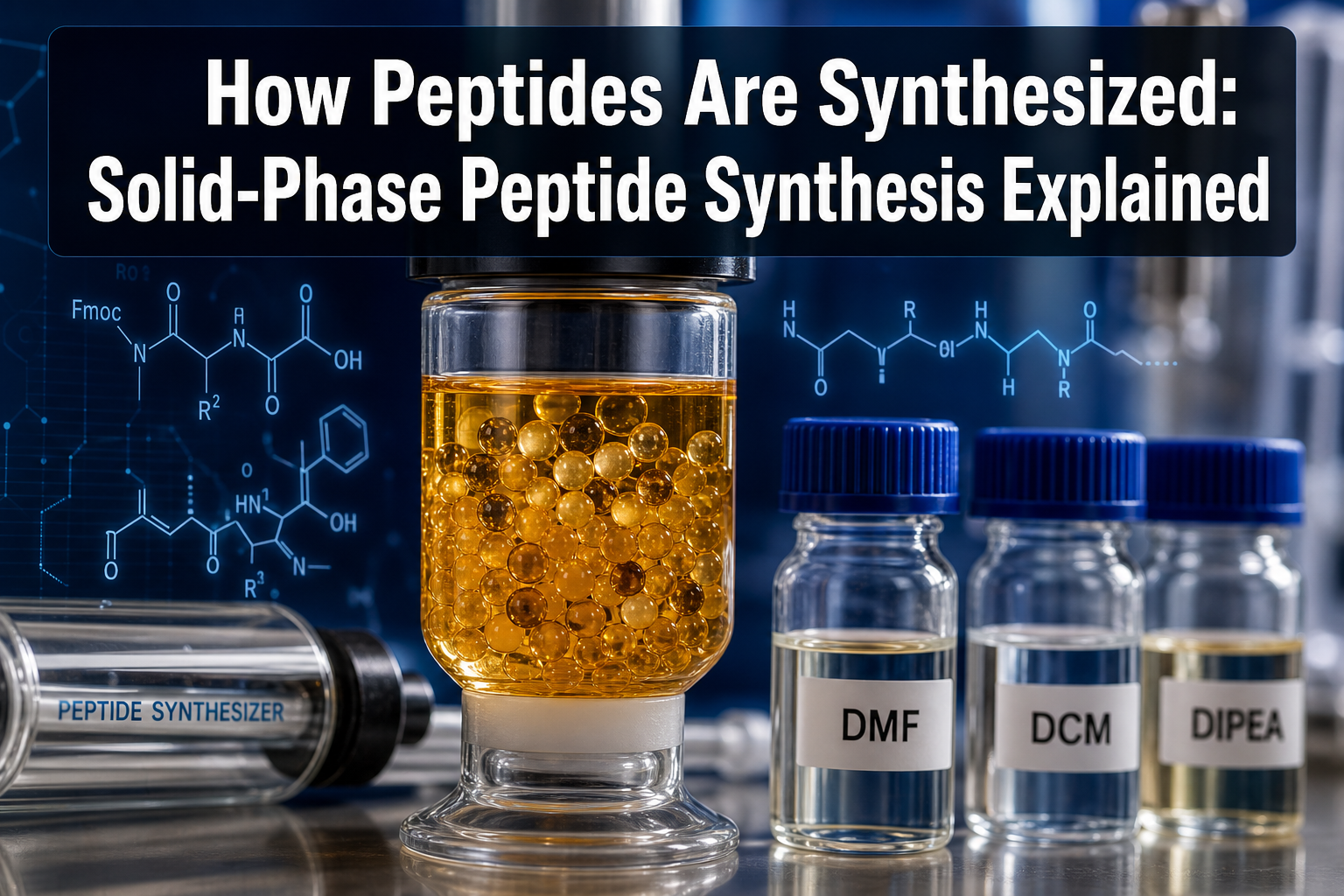
Solid-phase peptide synthesis (SPPS) is a method for building peptides by sequentially attaching protected amino acids to a resin bead that acts as an insoluble anchor. Because the growing chain stays fixed to the solid support throughout the process, excess reagents and byproducts can be washed away easily between each step, which is the core advantage over older solution-phase methods.
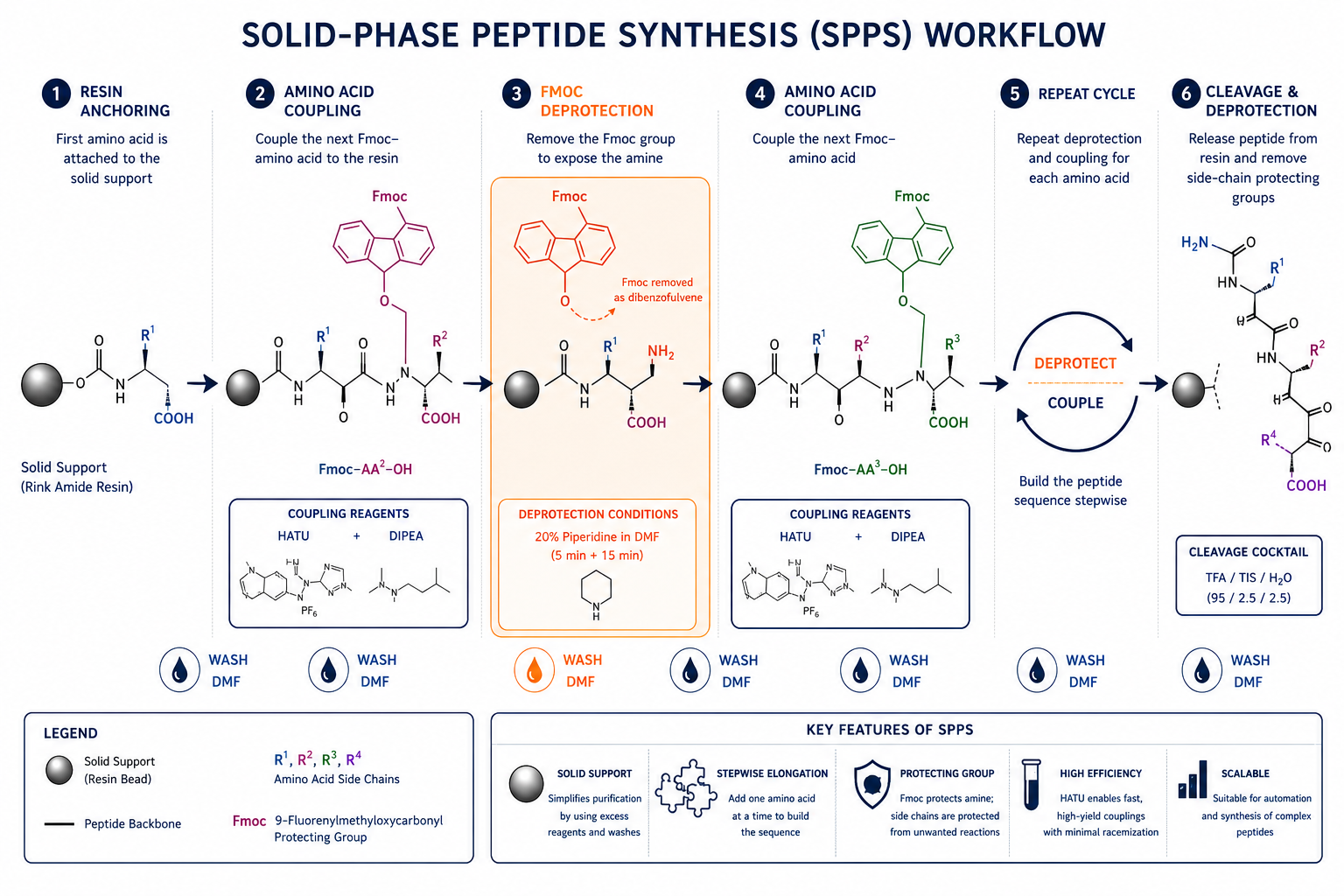
The concept was introduced by Robert Bruce Merrifield in 1963 and earned him the Nobel Prize in Chemistry in 1984. The basic logic is straightforward: start with an amino acid already attached to a resin, remove its protecting group, add the next amino acid in the sequence, form a peptide bond, wash, and repeat. When the full sequence is complete, the peptide is chemically cleaved from the resin.
Key components of SPPS:
- Solid support (resin): Polystyrene or PEG-based beads that swell in organic solvents, giving reagents access to the growing chain.
- Protected amino acids: Each amino acid has a temporary protecting group on its alpha-amine (removed each cycle) and permanent side-chain protecting groups (removed only at cleavage).
- Coupling reagents: Chemicals like HATU or DIC that activate the carboxyl group of the incoming amino acid so it can form a peptide bond.
- Base: DIPEA (Hünig’s base) neutralizes the reaction environment during coupling.
Why Use Solid-Phase Synthesis Instead of Liquid Phase
SPPS is preferred over liquid-phase synthesis because purification between steps is dramatically simpler. In liquid-phase synthesis, each intermediate must be isolated and purified before the next step, which is time-consuming and leads to significant yield losses. With SPPS, excess reagents are simply filtered and washed away because the peptide chain stays bound to the resin.
Additional advantages include:
- Easy automation, since the wash-couple-deprotect cycle is repetitive and machine-friendly.
- Scalability from milligram to multi-gram quantities.
- Compatibility with a wide range of amino acid building blocks, including non-natural amino acids.
The main limitation of SPPS is that errors accumulate with chain length. Each coupling step is not 100% efficient, so longer peptides carry a higher burden of deletion sequences and truncated products, requiring more rigorous purification.
What Are the Main Steps in SPPS Peptide Synthesis
Each synthesis cycle in SPPS follows the same four-step pattern, repeated for every amino acid in the target sequence.
Step-by-step cycle:
- Deprotection: Remove the temporary protecting group (Fmoc or Boc) from the alpha-amine of the resin-bound amino acid using a base (piperidine for Fmoc) or acid (TFA for Boc).
- Washing: Flush the resin with solvent (typically DMF) to remove the deprotecting agent and byproducts.
- Coupling: Add the next protected amino acid, activated by a coupling reagent (HATU, DIC, or HBTU), so it forms a peptide bond with the free amine.
- Washing again: Remove excess amino acid and reagents before the next cycle begins.
After all residues are added, two final steps complete the synthesis:
- Cleavage: A TFA-based cocktail releases the peptide from the resin and removes side-chain protecting groups simultaneously.
- Purification: The crude peptide is purified, typically by reverse-phase HPLC.
What Is the Difference Between Fmoc and Boc Protection Strategies
The Fmoc and Boc strategies differ in the chemistry used to protect and deprotect the alpha-amine at each cycle. Fmoc (9-fluorenylmethoxycarbonyl) is removed by a mild base (20% piperidine in DMF), while Boc (tert-butyloxycarbonyl) requires a strong acid (TFA) for each cycle.
| Feature | Fmoc | Boc |
|---|---|---|
| Deprotection agent | Piperidine (base) | TFA (acid) |
| Final cleavage | TFA + scavengers | HF (hazardous) |
| Equipment needed | Standard lab | HF apparatus required |
| Side-chain protection | Acid-labile groups | Base-labile groups |
| Preferred for | Most research peptides | Certain complex sequences |
Choose Fmoc if you are working in a standard organic chemistry lab without HF handling capability. Fmoc is the default choice for the vast majority of academic and industrial peptide synthesis today. Choose Boc if the target sequence contains acid-sensitive modifications or if the lab is already equipped for HF chemistry.
What Solvents and Reagents Are Used in SPPS
The primary solvent in SPPS is dimethylformamide (DMF), which swells polystyrene resins and dissolves most protected amino acids and coupling reagents. Dichloromethane (DCM) is used for washing and some coupling steps, particularly in Boc chemistry.
Common reagents:
- Coupling reagents: HATU, HBTU, DIC, PyBOP
- Activating additives: HOBt, HOAt (reduce racemization)
- Base: DIPEA or NMM
- Deprotection (Fmoc): 20% piperidine in DMF
- Cleavage cocktail: TFA with scavengers such as water, triisopropylsilane (TIPS), and ethanedithiol (EDT) to quench reactive carbocations
Proper solvent handling and waste disposal are essential. DMF and DCM are both hazardous solvents requiring fume hood use and appropriate waste management protocols.
What Equipment Do You Need for Solid-Phase Peptide Synthesis
At minimum, SPPS requires a reaction vessel with a fritted filter (to retain resin while allowing solvent drainage), a vacuum or nitrogen line for filtration, and a fume hood. Manual synthesis is feasible for short peptides but becomes impractical for sequences longer than 10 residues.
Standard lab setup:
- Manual synthesizer: fritted syringe or peptide synthesis vessel, orbital shaker
- Automated synthesizer: instruments from companies such as CEM, Biotage, or Gyros Protein Technologies handle reagent delivery, timing, and washing automatically
- Rotary evaporator or lyophilizer: for removing solvents from the crude peptide after cleavage
- HPLC system: for purification
- Mass spectrometer (LC-MS): for identity confirmation
Automated synthesizers range from bench-top research models to large-scale GMP instruments used in pharmaceutical manufacturing. Entry-level automated systems cost roughly $30,000 to $80,000 (estimated range based on published vendor pricing as of 2025).
How Long Does It Take to Synthesize a Peptide
A single coupling-deprotection cycle takes approximately 30 to 60 minutes, depending on the method and equipment. A 20-residue peptide synthesized on a modern automated instrument typically takes 10 to 24 hours of instrument time. Microwave-assisted SPPS (used in instruments like the CEM Liberty series) can compress cycle times to under 5 minutes per residue.
Add 1 to 3 days for cleavage, precipitation, and HPLC purification. Total turnaround from starting synthesis to receiving a purified, lyophilized peptide is typically 3 to 7 business days in a well-equipped core facility.
How Do You Remove Peptides from the Solid Support
Cleavage is performed by treating the resin-bound peptide with a TFA-based cocktail for 1.5 to 3 hours at room temperature. The cocktail contains scavengers that neutralize reactive species generated when side-chain protecting groups are removed simultaneously.
After cleavage, the resin is filtered off and the filtrate is concentrated. The crude peptide is then precipitated by adding cold diethyl ether, collected by centrifugation, and dried before purification.
How Do You Purify Synthesized Peptides
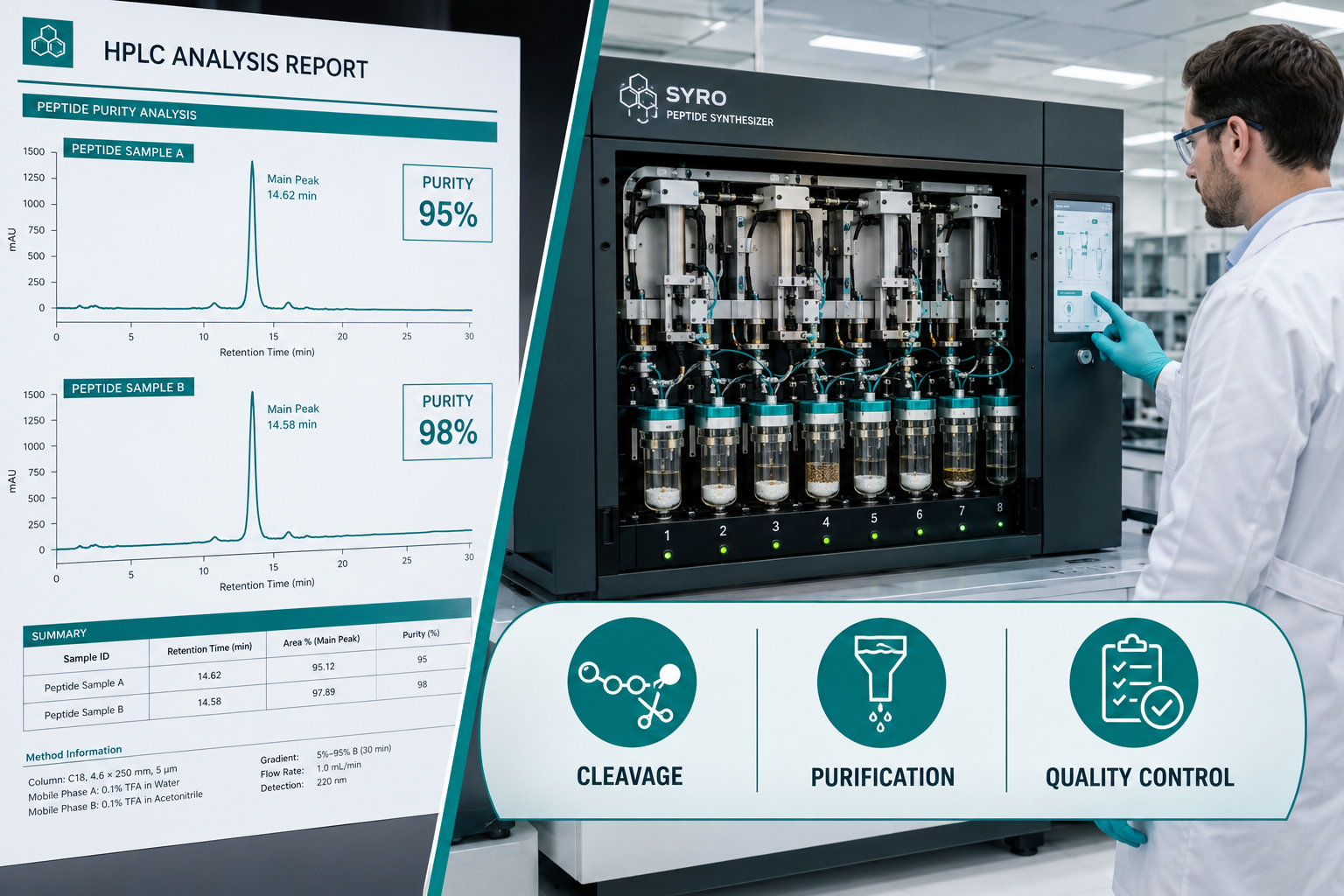
Crude peptides from SPPS are purified by reverse-phase HPLC (RP-HPLC) using a C18 column and a water-acetonitrile gradient with 0.1% TFA. Purity targets of 95% or greater are standard for research use; pharmaceutical-grade peptides typically require 98% or higher purity.
After HPLC, fractions containing the target peptide are pooled and lyophilized to give a dry powder. Mass spectrometry (ESI-MS or MALDI-TOF) confirms the molecular weight and identity of the final product.
What Size Peptides Can You Make with SPPS
SPPS works best for peptides of 5 to 50 amino acids in length. Sequences up to about 30 residues are routinely synthesized with high efficiency. Beyond 50 residues, cumulative coupling failures and aggregation of the growing chain on the resin reduce yields significantly.
For longer sequences (50 to 100+ residues), chemists use native chemical ligation (NCL) to join two or more shorter SPPS-made fragments. This strategy was used to synthesize proteins such as HIV protease (99 residues) in research settings (Schnölzer & Kent, 1992).
Is Solid-Phase Peptide Synthesis Expensive
Cost depends on length, purity, quantity, and whether synthesis is done in-house or outsourced. Academic core facilities typically charge per residue, with estimates ranging from $5 to $30 per residue for standard Fmoc synthesis. A 20-residue peptide at 95% purity might cost $200 to $600 from a core facility or commercial vendor.
Reagent costs for in-house synthesis are lower per peptide once equipment is in place, but instrument acquisition, maintenance, and solvent disposal add to the total cost of ownership. For small quantities of short peptides, outsourcing to commercial suppliers is often more cost-effective than maintaining in-house capability.
How Do You Know If Your Peptide Synthesis Worked
The two primary quality control tools are mass spectrometry and HPLC. Mass spectrometry confirms that the peptide has the correct molecular weight, which verifies the amino acid sequence was assembled correctly. HPLC measures purity by showing what fraction of the total UV absorbance corresponds to the target peptide peak.
Common QC benchmarks:
- Correct molecular ion by ESI-MS or MALDI-TOF: confirms identity
- HPLC purity above 95%: acceptable for most research applications
- Amino acid analysis: optional, confirms composition quantitatively
A peptide that passes both MS and HPLC checks is considered successfully synthesized and suitable for most downstream applications.
What Are Common Mistakes in Peptide Synthesis
Even experienced chemists encounter problems in SPPS. The most frequent issues and how to address them:
- Incomplete coupling: Results in deletion sequences. Use double coupling for difficult sequences or switch to a more reactive coupling reagent like HATU.
- Aggregation on resin: Long hydrophobic sequences can fold and block access to the growing chain. Use pseudoproline dipeptides or PEG-based resins to disrupt aggregation.
- Aspartimide formation: Asp residues can cyclize under basic conditions. Use Asp(OtBu) with backbone protection or minimize piperidine exposure time.
- Racemization: Using too much base or leaving activated amino acids in solution too long. Add HOAt or HOBt as additives.
- Poor cleavage: Insufficient scavengers in the TFA cocktail leave side-chain protecting groups intact. Optimize the cleavage cocktail for the specific sequence.
Can You Synthesize Peptides at Home or Do You Need a Lab
Peptide synthesis at home is not feasible and is strongly inadvisable. SPPS requires DMF, DCM, TFA, and piperidine, all of which are hazardous chemicals that require fume hoods, proper storage, and regulated waste disposal. Coupling reagents like HATU are moisture-sensitive and require controlled handling. Automated synthesizers are expensive, and HPLC purification requires additional specialized equipment.
In short: SPPS is a laboratory technique that belongs in a properly equipped chemistry lab with trained personnel and institutional safety infrastructure. Researchers without access to in-house synthesis capability should use commercial peptide synthesis services or academic core facilities.
Frequently Asked Questions
What is the difference between a peptide and a protein?
Peptides are short chains of amino acids, typically fewer than 50 residues. Proteins are longer polypeptide chains that fold into defined three-dimensional structures. The boundary is not rigid, but most biochemists treat chains under 50 residues as peptides.
Can SPPS make cyclic peptides?
Yes. Cyclic peptides are made by on-resin or in-solution cyclization after the linear chain is assembled. Head-to-tail cyclization, side-chain-to-backbone cyclization, and disulfide bridge formation are all achievable with SPPS-derived linear precursors.
What is a resin loading and why does it matter?
Resin loading refers to the number of reactive sites per gram of resin (measured in mmol/g). Higher loading gives more peptide per gram of resin but can increase aggregation. Most standard resins are loaded at 0.2 to 0.7 mmol/g.
How do I choose between Fmoc and Boc strategies?
Choose Fmoc for standard sequences in a typical organic chemistry lab. Boc requires HF for final cleavage, which demands specialized equipment and safety training. Fmoc is the practical default for most researchers.
What is a coupling efficiency and how is it measured?
Coupling efficiency is the percentage of free amines that successfully react with the incoming amino acid in each cycle. It is measured by the Kaiser test (ninhydrin test), which turns blue in the presence of free amines, or by quantitative UV monitoring of Fmoc removal.
What happens if a coupling step fails?
Unreacted amines can be capped using acetic anhydride (a step called capping) to prevent them from reacting in later cycles, which would produce truncated sequences that are hard to separate from the target peptide.
How are non-natural amino acids incorporated into SPPS?
Non-natural amino acids with compatible Fmoc or Boc protecting groups are incorporated exactly like standard amino acids, as long as they are available as activated building blocks. Some require modified coupling conditions or longer reaction times.
What is native chemical ligation?
Native chemical ligation (NCL) is a technique that joins two unprotected peptide fragments at a cysteine residue under aqueous conditions. It extends SPPS to proteins well beyond 50 residues by ligating shorter SPPS-made segments.
Is SPPS used to make FDA-approved drugs?
Yes. Several approved peptide drugs, including semaglutide, liraglutide, and oxytocin, are manufactured using SPPS or hybrid SPPS/recombinant approaches at industrial scale.
How should synthesized peptides be stored?
Lyophilized peptides should be stored at -20°C in a dry, dark environment. Peptides in solution degrade faster and should be aliquoted and stored at -80°C to minimize freeze-thaw cycles.
Conclusion
Understanding how peptides are synthesized, and specifically how solid-phase peptide synthesis works, is foundational knowledge for anyone working in biochemistry, drug discovery, or molecular biology. SPPS offers a reliable, automatable, and scalable route to custom peptide sequences, provided the right chemistry, equipment, and quality controls are in place.
Actionable next steps:
- If you need a custom peptide for research, compare pricing and turnaround times from at least three commercial suppliers or your institution’s core facility before committing.
- For sequences longer than 30 residues, ask the supplier about their coupling efficiency data and whether they use microwave-assisted synthesis to reduce deletion sequences.
- Always request both HPLC purity data and MS confirmation with your order; do not accept a peptide lot without both.
- If you are setting up in-house synthesis capability, start with an automated Fmoc synthesizer and a C18 HPLC column before investing in more specialized equipment.
- For sequences prone to aggregation or containing difficult motifs (multiple prolines, long hydrophobic stretches), consult with a peptide chemist before ordering, since sequence redesign or modified synthesis strategies may improve yield significantly.
References
- Merrifield, R. B. (1963). Solid phase peptide synthesis. I. The synthesis of a tetrapeptide. Journal of the American Chemical Society, 85(14), 2149-2154. https://doi.org/10.1021/ja00897a025
- Schnölzer, M., & Kent, S. B. H. (1992). Constructing proteins by dovetailing unprotected synthetic peptides: backbone-engineered HIV protease. Science, 256(5054), 221-225. https://doi.org/10.1126/science.1566069
- Amblard, M., Fehrentz, J. A., Martinez, J., & Subra, G. (2006). Methods and protocols of modern solid phase peptide synthesis. Molecular Biotechnology, 33(3), 239-254. https://doi.org/10.1385/MB:33:3:239
- Isidro-Llobet, A., Álvarez, M., & Albericio, F. (2009). Amino acid-protecting groups. Chemical Reviews, 109(6), 2455-2504. https://doi.org/10.1021/cr800323s
- Behrendt, R., White, P., & Offer, J. (2016). Advances in Fmoc solid-phase peptide synthesis. Journal of Peptide Science, 22(1), 4-27. https://doi.org/10.1002/psc.2836
Meta Title: How Peptides Are Synthesized: Solid-Phase Peptide Synthesis
Meta Description: Learn how peptides are synthesized using solid-phase peptide synthesis (SPPS). Covers Fmoc vs Boc, steps, reagents, purification, costs, and common mistakes.
Tags: peptide synthesis, solid-phase peptide synthesis, SPPS, Fmoc chemistry, Boc chemistry, amino acid coupling, peptide purification, HPLC peptides, peptide chemistry, resin cleavage, custom peptides, peptide synthesis reagents
